When he came, I knew he was different than the other healers. Legion was afraid, and he was never afraid. His fear covered me like a sheet, hiding for just a moment all the rationality I had left. But he retreated so far into his own fear that I suddenly was free of him, just for a moment, and I dropped the rock that I had been using to slice open my arm again. I stood, the blood streaking down my forearm as I ran naked from the tombs. Legion’s fear overtook me again and I found myself in his control again, falling to my face at this healer’s feet.
I heard my voice, but the words were not my own. “What have you to do with me, Jesus, Son of the Most High God?” I said. The other demons were stirring now, wailing, and their wails were also escaping my mouth. I pulled at my hair, and writhed at his feet.
“Come out of him,” this Jesus said. He said it with authority, with power. I could feel the demons loosening within me, being shaken loose from my soul. I laughed, the hope I thought was dead like a spring bursting from the ground. Legion shook me, my body flopping and bouncing hard enough to against the ground to bruise me. My arm was still steadily bleeding. I was not covered in blood.
“What is your name?” Jesus asked.
I tried to answer that my name was Dositheus, but Legion used my mouth to answer instead. “My name is Legion, for we are many.” The many others who inhabited me shrunk away from the admission. I grasped at Jesus’ cloak, in tears, nearly blinded with pain, feeling all the fear of each one of them as my own.
“Do not send us away!” Legion cried. I was weeping now, and the demons were also weeping, unable to resist the power of Jesus, this extraordinary healer, this magician, this Son of the Most High God. I wondered how Legion knew. I wondered if he had encountered Jesus before. But my mouth did not speak my own words. Legion cried out again to Jesus, this time begging, “Send us into the swine!”
Jesus stood over me, watching me writhe and wail. The power was flowing out of him and the demons could not resist it. They were slipping from me, but they were not yet gone. “You may go into the swine,” Jesus said.
The commotion had gathered a crowd. I screamed as the demons left me in a flood. It was agony. They poured out of me like oil, and when they were gone, I collapsed to the ground, weeping with relief.
I heard the swine squealing with rage. I had a momentary sense of pity for them, but the realization that they were no longer a part of me had me in tears again, this time of joy. I raised my head to watch them, swarming across the hill. The crowd watching was tense with surprise and fear. When the wine began to jump into the sea, the crowd went silent. I watched as the whole herd fled back into the sea from which the demons had first come.
I looked up into the face of Jesus. He was smiling at me. His eyes were kind and his smile was warm. “What is your name?” he asked again.
“Dositheus,” I whispered. I was ashamed of my nakedness, as I had not been in years. I did not rise from the ground, hiding myself from him and those who had gathered.
Jesus crouched next to me, and put his hand on my face. “Be well, Dositheus,” he said.
Someone tapped me on the shoulder and when I turned to looked, I saw my mother. I embraced her with abandon, openly weeping into her shoulder. She cradled me in her arm, like she had when I was young. She whispered my name over and over as she stroked my hair. “Dositheus,” she said. “My son.” Her voice was a balm. I could hear it so clearly now that Legion and the demons were gone from me.
I pulled away from her, wiping my face with forearm. Now instead tears, there was blood on my face. My mother kissed my forehead, and then lifted a robe over my head. She dressed me and pulled me to my feet. “Come, I will take care of you,” she said.
She led me away from the tombs, and I could see Jesus at the bottom of the hill, the crowd pressing in around him as he began to climb into a boat. My mother and I moved through the crowd, to the very front where Jesus stood. He had launched the boat into the water already.
“Wait!” I called, as the lake began to carry him away. “Let me come with you!”
“Go home!” he called.
The crowd began to disperse, their interest in this mysterious healer gone now that he was leaving. But I stood watching until he was so far out on the lake that I could no longer see him. I contemplated how the sea had brought destruction to me, and how it has also mysteriously brought my salvation. My arm was still bleeding, though the flow was not a fierce as before. I pressed a hand to the cut, trying to staunch the flow.
“Come,” my mother said. “Come home with me.”
I went with her, wondering why Jesus had come, and where he was going next.
I can’t get away from them. A multitude inside. Legion invites them and they come. Sometimes I don’t even hear myself screaming because the screaming inside me is so loud. I cut myself to remember that I am me. I wail to remember that I have a voice too.
You will never be free of me, Dositheus.
When Legion talks to me it is like death. It is like there is another me in the grave, and he has come to share his thoughts. Legion’s voice is my own, and he tells me where I can go, what I can do. I listen to him because I can’t refuse. Sometimes he controls me, and I disappear. It is not always so. Not when my mother comes to bring me food.
“Dositheus,” she says sadly. “Please eat, Dositheus.” She pushes the plate towards me. The demons inside me retreat for a moment. Legion is calmed by my mother’s presence. I am afraid that if I get too close to her that he will leave and go into her. She pleases him and I am terrified.
Eat, Dositheus. Do as Mother says.
I take the plate, dragging it across the ground with one hand, my eyes never leaving my mother. She smiles at me. I am still her son. She still loves me.
“Will you wear this?” she asks. She offers the tunic to me. It is fresh, never worn. She hold out the linen garment to me, her posture one of earnestness.
I look down my body- naked, scarred, dirty. “I can’t wear it,” I saw. “I’m not clean. It will stain.”
Mother smiles at me, a sigh of relief escaping her that it is me who speaks and not the demons. “I will bathe you,” she says, her eyes expectant, pleading. “Come home with me, and I will help you.”
I eat the food slowly, thinking.
We like it here among the dead. We will stay here, Dositheus.
“No. No. No,” I say. I repeat it too many times. I pull my hair until it begins to rip from my head. I spill the remaining food to the ground. “Let me be. Leave me alone.” The wailing begins and for a moment I don’t understand that it is me who wails.
My mother touches my arm. It shocks me from the screams inside me, the screams I offer. I catch her hand in mine. She has tears in her eyes. I let out a sob. She takes me into her arms like I am a child. I am a child. I am a child. A lost child. She smells like olive oil. She skin of her face as it presses against mine is warm. Her dress is soft. She cradles me until the sobs cease to wrack me.
You will not go with her.
Legion laughs at me. I pull away from my mother violently. I take the plate she brought and I fling it far from me as I scream. I rise from the ground and I scream into the sky. Over and over and over until I am hoarse and exhausted. I don’t know how long it went on. Too long. Too many demons. Too long inside me.
“And when he had stepped out of the boat, immediately a man with an unclean spirit met him. He lived among the tombs, and no one could restrain him any more, even with a chain, for he had often been restrained with shackles and chains, but the chains he wrenched apart, and the shackles he broke in pieces, and no one had the strength to subdue him. Night and day among the tombs and on the mountains he was always howling and cutting himself with stones.”Mark 5: 2-5
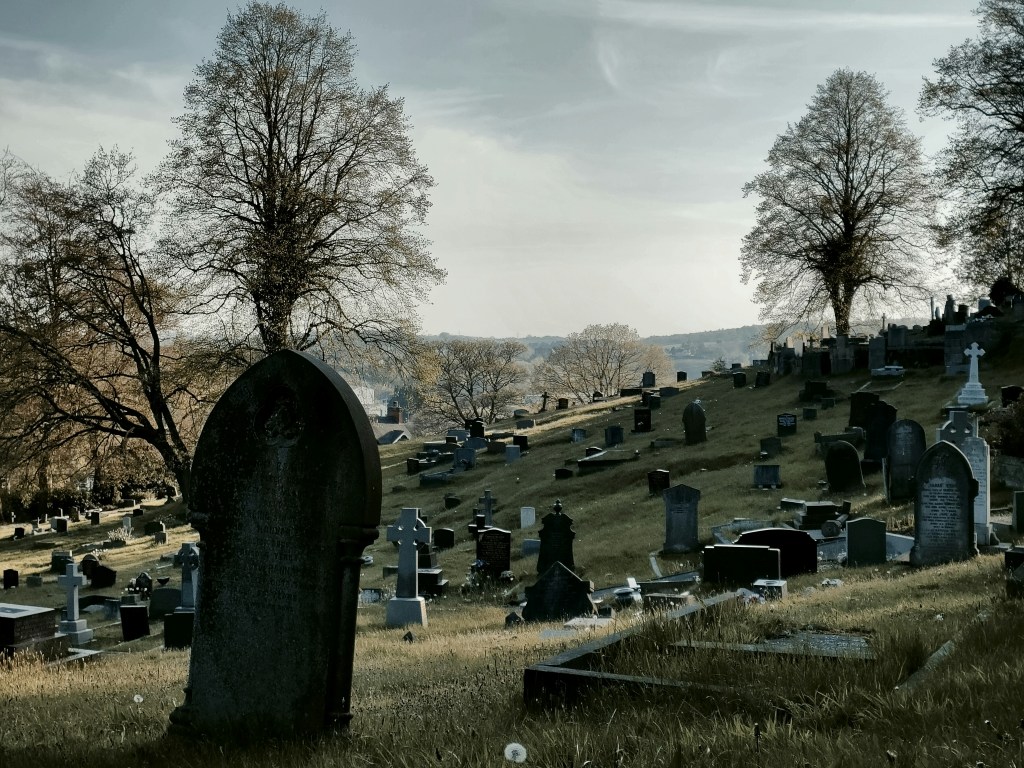
I was driven into this place by my family. The burden on them was too great, and so they released me. I live here among the dead because the dead do not disturb me. I am too disturbed already, and their silence is solace, unlike the living. Too many voices in my head. Too many. Too many. The voices of my family, of my old friends were loud amongst the chatter within me. The great multitude of being who have taken residence inside me.
I used to sit on the shore when I was boy, looking out across the water, wondering if I would ever see what was on the over side. That great chaos, full of wonder, mystery. And monsters. I don’t know if this was what invited him in. My curiosity. Stupidity! Or if it was something else- something I said, or did not say, or a curse placed upon me. Or perhaps the wrong person found out my name. Perhaps the one who calls himself Legion knew he was more powerful than me. And he came, and now I belong to him.
I was walking along the seashore when he came. He was a darkness on the deep, he movement barely noticeable, but his presence like a brewing storm. I flinched, convulsing as I went down. I do not know who found me. Perhaps a stranger. Perhaps my mother. I was just a boy. Small boy. So small. Too small for this. Weak. And made weaker by Legion.
I cried at night. My mother thought I was sick. She called physicians and magicians and healers and spirit workers from everywhere. They tied me when I thrashed, when I foamed at the mouth, when I lost my mind with rage. I felt inhuman. But my mother never looked at me like I was anything but her son. I am not. I am not. I am not. Not anything anymore. She kept me in the house against my father’s wishes.
“Throw him into the sea,” my father said. “Put the demon inside him back where it came from!”
The demons. The demons. There are demons. Many. Too many.
“No,” she said. My mother was kind to me. She believed I could be healed. She believed that someone would come to heal. She believed. I don’t believe anything anymore.
My father died. He grew ill after cutting his hand on a sickle. His hand withered, rotted. Then one day, he was dead. We mourned. The demons laughed.
He would have killed me. They all would have killed me if not for her.
“What do we do with Dositheus now?” asked my brother, as if I could not hear him from where they had tied me in the corner of the room. They had not let me out of the house to attend the funeral procession, or to mourn. Too wild. You have become inhuman. I stared wild eyed, crying, wailing. My father was dead. I was as good as dead.
My mother wrung her hands. “Untie him,” she said.
He did as she said. It was nightfall, and the demons always tormented the most when the sun was sinking. Sabbateus untied me, and I thrashed on the floor, wailing and pulling my hair. “Mother!’ I cried. “Mother!”
She held me, but Legion was too strong. I hurt her, pushing her over hard. I ran from the house. The little house by the sea where I lived. Until I came here. I don’t know how long I have been here, among these tombs. I will die here. I am already dead.
Sabbateus came for me, found me rolling on the seashore. I was hungry and thirsty but I could not ask for what I needed. He led me home. They bound me again. My mother fed me. Legion was calm sometimes when my mother was close. She quieted the chatter, the banter, the constant fighting within me. I loved her. She loved me despite what I had become.
“You are my son, Dositheus,” she said, wiping my chin. The cool water she offered me had been dribbling down my chin. “You are my son, and I love you.”
But love could not heal me. Love could not keep her safe from me. When she untied me, I hurt her, though I didn’t want to. It was Legion! It is always Legion who does it.
I grew, and the demons inside me grew stronger as my body matured. They found a blacksmith to bind me with chains. They shackled me in the house. Legion used to beat my hands against the floor until they were bloodied, trying to break the chains apart. He always did. And when we escaped, he always took me by the seaside, looking out over the water. But he never let me die. I wanted so badly just to die.
My mother still comes to see me. She can’t stay away, when my wailing drifts through the night air. She leaves me food. I eat sometimes, especially if she is near. Legion likes my mother. He leaves me less clouded when she comes near. I let her touch me, although I am afraid to touch her. She strokes me cheek and my hair as if I were still a small boy. She leaves me clothes, but I don’t need them. I am dead. I am waiting to die.
The stones are my only friends, as are the dead. No one comes but Mother. No one will ever come for me here. I am alone with Legion and his many minions.
Getting a Masters in Religion, especially since I focused on Biblical Studies, has filled my head with a number of things that I would love to hear and say from the pulpit. Hard topics are not typically the ones that get preached, but it is the hard topics that captivate my imagination the most. What if instead of giving easy answers that always point towards the fulfillment of scripture in Jesus’ ministry, we really let people wrestle with the text, the way Jacob wrestled all night, and was wounded for the rest of his life because of it? What if instead of always coming back to the same ideas of grace, mercy and love, that we recognized without our scriptures are stories that we can easily use as proof to do the opposite? I have no idea if I will ever get to share these ideas in a more public way, but it feels right to voice them nonetheless.
Hagar and Sarai (Gen 16)
Can we stop looking at this text as if one of the women loses and the other gains? I don’t see anyone in this story gaining anything other than a complicated mess. If we push past the tendency to pick a side, I think we can see that both women are trapped in systems that do not benefit either one of them, and these systems also prevent them from working towards their mutual good.
Samuel and Eli (1 Sam 3)
Can you imagine being a child and having to tell Eli, the priest of all Israel, that his sons are so corrupt, and that it reflects on his leadership? Do you hear the quaver in Samuel’s voice when he tells Eli that he will be replaced? Do you feel the weight of the words he speaks, a small voice given authority to speak the truth to a mighty power? And what is Eli’s response? “Let it be.” What a perfect example of humility.
Vashti (Esther 1)
Vashti said no. She said no to being used, to being a tool for the powerful, to being a plaything for her husband and his friends, to be a possession to prop up his ego. She said no despite what it would cost her. How brave.
The Woman Healed from Her Flow of Blood (Mark 5)
The desperation that drove this unnamed woman to touch the hem of Jesus’ garment must have been so powerful, that the story made a remarkable impression upon the writer of the text. Her story interrupts the story of a man asking for healing for his daughter. Her story represents the millions of people who live with chronic illness and yet somehow must live their lives. That Mark includes a case of healing from gynecological disease should give us hope that the gospel is powerfully inclusive. Jesus’ ministry includes women’s and reproductive health. Are we preaching the same kind of gospel?
The Faith of the Father of a Demon Possessed Boy (Mark 9)
Asking for a miracle for his son, this unnamed man utters “I believe! Help my unbelief.” And isn’t that a wonderful five word summary of the whole journey of faith?
“You shall not hate in your heart anyone of your kin; you shall reprove your neighbor, or you will incur guilt yourself. You shall not take vengeance or bear a grudge against any of your people, but you shall love your neighbor as yourself; I am the LORD.”
Leviticus 19:17-18
Are you still supposed to love your neighbor as yourself
When the kind of love you give yourself
Is the tough kind that makes you cry?
It doesn’t seem to me that that’s the kind of love
That God intended.
If you’re supposed to love you neighbor as yourself
I have been spending a lot of my time reading and re-reading the text of Genesis 12-25 as I work on writing my master’s thesis. In the project, I am exploring the family of Abraham, and the many systems within the narrative that create conflict between the characters. As part of my analysis, I have written some midrash for each of the key characters, based on the research I have done and the pieces of the text I want to pull to the forefront. This last piece is about Isaac.
Rebekah, please tell me if I’m not thinking clearly. I want to be righteous, but I feel that I can’t when there are all these questions I have about myself, about my father. Why me, Rebekah? Why us? Why did God choose my father, and why did God choose me over Ishmael? Why am I any more special than anyone else?
I thought, when my father took me to Moriah, that it would be the end of it. My special status would be confirmed to everyone as I went up in flames. The first human offering to God. That is why God waited so long before he opened by mother’s womb. I was a miracle child, and I would become a witness to God’s loyalty in the fire. I would be made a sacrifice so that my father would be seen as the holiest of men. And in some way, I too was to be made holy because of my death.
But this is not what God wanted from either of us. It was only a test. It tested my father’s faith, but I think it also broke him in some ways. As for me…I feel betrayed by it. Betrayed by my father, and betrayed by God. How could this thing be asked of either of us? Why would my father ever have agreed to take me up that mountain at all? Is it because I was special, or was it because I was replaceable?
You frown! I knew I should not be thinking these things. Tell me, please, is there another way I should feel about all this? I have thought about that moment every day since it happened, how terrified I was, but how I also saw no way out. And I thought of my brother, and Hagar, living in the wilderness. I thought of my mother, and what she must have thought when we were packing up the camels. I thought of the servants, who would wonder why I had not come down the mountain afterwards, and what my father would say to them. I thought, with horror, that no one would know how holy I was to become if no one was there to witness my death!
Don’t turn your head from me, Rebekah! I can see that this distresses you, just as it distresses me. But I must know, if my father was willing to kill me to prove his faith, does that mean I was born, chosen by God, so my father could be seen in this light? Or is there something else that makes me chosen? Some other quality within me that I simply cannot see? Or is it only the fact that I am Abraham’s son?…or perhaps, is it that I am Sarah’s son? Is she the one who was special, and we just never knew it? Don’t laugh at me! Please Rebekah, if you love, tell me the truth. What do I have that no one else does? Why am I singled out? What is it about me that makes me worthy?
I can see that you do not have any more answers for me than I have for myself. I think, now that my mother has passed, I will need to find Hagar and Ishmael. I should ask my brother about these things. Perhaps he has some insight into my father that I cannot see, and will never see after the events at Moriah. Yes, I need to find my brother. I need to understand why neither one of us is as important as our father.
I have been spending a lot of my time reading and re-reading the text of Genesis 12-25 as I work on writing my master’s thesis. In the project, I am exploring the family of Abraham, and the many systems within the narrative that create conflict between the characters. As part of my analysis, I have written some midrash for each of the key characters, based on the research I have done and the pieces of the text I want to pull to the forefront. This week I share my thoughts on Hagar.
The midwife who had attended me was packing the diaper-like undergarment with old bits of cloth when Sarai came to see the baby. I was exhausted and wanted no visitors, but I could not refuse my mistress. She came into the tent without asking, nearly frantic. Her eyes shimmered with tears as she came, leaning her aged face over me to see my son. My son. I felt the stirring anger grow hotter as she cooed over the infant laying on my chest. The only reason she was here was to see the boy. I was nothing to her. She hadn’t considered what I wanted at all.
The midwife finished adjusting and jostling me, working around Sarai’s imposing frame without comment. I gritted my teeth as she pushed down on my belly once again, feeling for my womb, making slightly approving mutterings as she palpated me. I felt another gush of blood between my legs. Sarai didn’t notice my discomfort or my indecency. She didn’t seem to notice me at all. She was weeping openly now, eyeing the baby. My baby.
When she reached for my son, I did something I knew I should not do, something that I could never take back once it had been done. When she reached for my son, I clutched him to myself, so she could not take him. When she reached for my son, I turned my body away from her, so she could not even see him.
I peered over my shoulder at her. The joy melted from her face, replaced with surprise, sternness following on its heels. “Let me hold my son, Hagar,” she instructed me.
I did not think. I did not know how the next words I spoke would impact my future, and the future of my boy. I could not do anything but defend myself and my baby from Sarai’s overreaching, indifferent dismissal. I did not think. I spoke only the truth in my heart. “He’s my son.” I could feel my scowl deepening as Sarai pulled back from me. I saw it reflected in her own expression back to me.
“Hagar,” she began, perhaps thinking to chastise me for my insolence. But she did not have the chance before we were interrupted by a commotion outside.
Abram came into the tent, much to the surprise of everyone present. Such a thing was not done. It was a defiance of custom, an unraveling of the sacred space of birth. But Abram, bursting through the tent flap with a joyous sound looked as if custom and norms were the last things on his mind. “My son!” he called out I could hear men outside the tent, calling for Abram to come out. “Let me see him!” he said to me, as he rushed to where I reclined.
Too shocked to disobey him, as I had moments before disobeyed my mistress, I offered the boy to his father, who snatched him up into his arms, as he was crying and praying aloud and praising his god. As I watched him, my own eyes stung with tears because of what I knew to be true. The boy was not mine. This boy belonged to Abram. No one would care who the mother was. No one would care that it was me who finally gave Abram what he desired most. All they would see is that Abram now had a son.
My eyes slid to Sarai, whose joy was now gone as she studied her husband with the baby. Though she didn’t speak to me, didn’t so much as look at me, I could tell that her thoughts were similar to my own. This baby did not belong to either of us. This baby was Abram’s.
And I saw her displeasure as clearly as I felt my own.
I have been spending a lot of my time reading and re-reading the text of Genesis 12-25 as I work on writing my master’s thesis. In the project, I am exploring the family of Abraham, and the many systems within the narrative that create conflict between the characters. As part of my analysis, I have written some midrash for each of the key characters, based on the research I have done and the pieces of the text I want to pull to the forefront. This week I share my thoughts on Ishmael.
When my mother laid me under that bush, to cool me from the scorch of the sun, I thought it was where I would die. Indeed, I wanted to die. My father had cast me away, listening to the voice of her first woman, Sarah. She did not like my mother, though they had tolerated one another all my life. But when my brother was born, we all could see how Sarah retreated into herself, becoming almost obsessed with protecting the boy from any danger. I guess he saw me as a danger too, and that is why she was eager to be rid of me.
I loved my brother! If I had known that my happiness at the feast would have been my undoing, my exile, I would have pretended indifference. I would have acted as my mother did, dutiful, grateful, but never warm, never loving. I loved my father, but my mother did not. Though I know he loved me, I don’t think he ever thought of my mother. That’s why it was easy for him to throw her away. But I never imagined he would throw me away too.
As I laid under that bush, thinking of my father, and all he had taught me, I could think of nothing to do with the pain that grew in my chest other than cry of to God—God, whom my father had taught me about, to whom my father had taught me to pray. I called out to God, crying out for death, begging to be taken from the pain of my father’s rejection. I called, and God answered me.
At first, I thought I was delirious from the heat, and from dehydration, and from fatigue. I saw the angel speaking with my mother, and I saw the spring gush from the rock. My mother filled the water skin and hastily brought it to me, forcing it down my throat. The angel stood by for a moment, watching. He did not speak to me and I did not speak to him. But I saw his flaming eyes, and I knew that God would not grant me death. No, God would grant me a new life. God would rescue me.
I have lived in Paran since then, away from my father and my brother. I heard when Sarah died, but I did not visit them. I heard when my father married again, but I was not invited to the wedding feast. I heard that my father had more sons, and that like me, he sent them away from him, so they would not share his wealth with Isaac. I do not understand these things. My father has forgotten everyone but Isaac. I wish I could also forget my fondness for him. It lives in me still, but I wish it would burn out.
But I have never forgotten my father’s God, the one who heard me and saved me.
I have been spending a lot of my time reading and re-reading the text of Genesis 12-25 as I work on writing my master’s thesis. In the project, I am exploring the family of Abraham, and the many systems within the narrative that create conflict between the characters. As part of my analysis, I have written some midrash for each of the key characters, based on the research I have done and the pieces of the text I want to pull to the forefront. This week I shared some thoughts about Abraham.
I have sent my sons—your brothers—away.
Lot, my brother’s son, whom I would have kept as my own, had I been able to—Lot was lost to me before he was destroyed in Sodom! I sent him away too, thinking it was best, thinking it was for his good and for me. I had need of him, but I also had a promise from YHWH. I did not think that I would lose him forever. I had hoped that we could reunite.
Your brother Ishmael—he pained me the most. For years before your birth, he was the joy of my household. The son whom I loved. The son of my body that YHWH promised to me—I was sure of it. But then your birth was foretold to me, and your mother birthed you through a miracle. I was happy, Isaac. I was happy to have you as well. But I loved your brother Ishmael, don’t you see? He is also my son. And Sarah and YHWH took him from me. I sent him away from my household. What kind of father am I?
And then, I shudder to think of it—the way I assumed YHWH would also take you from me—as Lot and Ishmael had been taken. And I didn’t even protest! I did not complain or question. I took you to Moriah, and raised a knife to slay you! What kind of father does these things? Don’t comfort me! I am ashamed of my weakness. I did not have the strength to save you from death, as I could not save my other sons.
But for you, Isaac, I have sent my sons, your brothers, away from me. I had to—don’t you see? I am a danger to the ones I love. There is no one YHWH cares about more than you. Everyone else is expendable—Lot, Ishmael, Hagar, even Sarah! Why would it be any different for Keturah and your brothers? It was to protect them that I sent them from me. If they are not part of my household, they cannot be part of this covenant that was made.
Now, promise me Isaac! When I die, take me to where I buried your mother. Lay my bones beside her bones in the cave I purchased to be her grave. Let me be reunited with her, my wife, my sister, my kin. She was right to leave after I took you to Moriah. I wish I could have told her what we saw there. I wish she would have understood what I had been through. I wish I hadn’t treated her the way I did.
But it is too late for me now, Isaac. My eyes close and my life nears its end and I have many regrets, many amends to make yet, that will never be made. Make them for me. Find your brothers that I sent away. Reconcile yourself to them, do not carry on the harms I have done. Do better by your own sons. Make a life worth living, one that does not end with thinking of all the harm you’ve caused the ones you loved. Don’t repeat my mistakes, Isaac! Follow God, but fight with God too. Fight for yourself and what you want. And teach your sons to do the same.







 The Quick and the Dead