During Lent, I’ll be writing six hymns that capture the spirit of reflection for the season. I will publish them on Sunday mornings. All the hymns will be set to well known tunes, so they will be easily shareable and singable upon reading.
Hymn 1 is titled Sit in Silence and in Prayer and uses the same tune as What a Friend We Have in Jesus (Converse).
Getting a Masters in Religion, especially since I focused on Biblical Studies, has filled my head with a number of things that I would love to hear and say from the pulpit. Hard topics are not typically the ones that get preached, but it is the hard topics that captivate my imagination the most. What if instead of giving easy answers that always point towards the fulfillment of scripture in Jesus’ ministry, we really let people wrestle with the text, the way Jacob wrestled all night, and was wounded for the rest of his life because of it? What if instead of always coming back to the same ideas of grace, mercy and love, that we recognized without our scriptures are stories that we can easily use as proof to do the opposite? I have no idea if I will ever get to share these ideas in a more public way, but it feels right to voice them nonetheless.
Hagar and Sarai (Gen 16)
Can we stop looking at this text as if one of the women loses and the other gains? I don’t see anyone in this story gaining anything other than a complicated mess. If we push past the tendency to pick a side, I think we can see that both women are trapped in systems that do not benefit either one of them, and these systems also prevent them from working towards their mutual good.
Samuel and Eli (1 Sam 3)
Can you imagine being a child and having to tell Eli, the priest of all Israel, that his sons are so corrupt, and that it reflects on his leadership? Do you hear the quaver in Samuel’s voice when he tells Eli that he will be replaced? Do you feel the weight of the words he speaks, a small voice given authority to speak the truth to a mighty power? And what is Eli’s response? “Let it be.” What a perfect example of humility.
Vashti (Esther 1)
Vashti said no. She said no to being used, to being a tool for the powerful, to being a plaything for her husband and his friends, to be a possession to prop up his ego. She said no despite what it would cost her. How brave.
The Woman Healed from Her Flow of Blood (Mark 5)
The desperation that drove this unnamed woman to touch the hem of Jesus’ garment must have been so powerful, that the story made a remarkable impression upon the writer of the text. Her story interrupts the story of a man asking for healing for his daughter. Her story represents the millions of people who live with chronic illness and yet somehow must live their lives. That Mark includes a case of healing from gynecological disease should give us hope that the gospel is powerfully inclusive. Jesus’ ministry includes women’s and reproductive health. Are we preaching the same kind of gospel?
The Faith of the Father of a Demon Possessed Boy (Mark 9)
Asking for a miracle for his son, this unnamed man utters “I believe! Help my unbelief.” And isn’t that a wonderful five word summary of the whole journey of faith?
There was a hum in the air around me. The expansive room was filled with other people, but I barely noticed them. I was centered on the statue in front of me. It had been placed behind a wall of glass to protect it, to separate it from the people who came to view it. It didn’t seem separated from me though, as I stood alone, wondering. The perfectly placed lighting highlighted all of Mary’s features so I could see her serene expression. For a moment, everything around me faded—the noise, the other visitors to the basilica, the tour guides giving lectures around me. For one holy moment, Mary and I were the only people in the room.
My eyes trailed over the body of the crucified Jesus laid across her lap. I felt particularly drawn to the way his hand dangled lifeless towards the earth, and the way the hand of his mother cradled him around his ribs. Michelangelo did not give him any wounds on his hands or feet, or in his side, but he didn’t need to. The agony of the crucifixion was carved into the way his body draped over Mary’s. I could almost imagine the strength of her legs, how the muscles in her arms must have strained under his weight. My eyes went back to her face, her perfectly serene face. This was not the face of a mother who had lost her son. There was a transcendent expression there, as if she had prepared herself for this. As if she always knew holding her son in this way is something she would one day do.
My ears tuned in to one of the tour groups in the basilica. The group was just a few feet ahead of me, and I could hear their guide clearly. She was explaining the debate about Mary’s youth. Why, she asked, did Michelangelo choose to make Mary so young when he carved his famous Pieta? She would have been in her forties when Jesus was killed, but Michelangelo’s Mary appears to be a young woman. The guide offered several explanations before sharing what she named to be her favorite. “This is not Mary holding the crucified Christ,” she said. “This is a statue of Mary holding the infant Jesus, imagining what her son would do for her.”
I looked at Mary’s face again, tears stinging my eyes, as I contemplated the price she paid.
I don’t claim to know how salvation actually works. I’m still unclear why Jesus died, and how his death is redemptive. I admittedly don’t like to think about his death at all, because uncertainty swirls around it when I do. The nagging questions—why?—never seem to fall away from me. Doubt is always mingling inside me, running right alongside faith. But that day, I didn’t feel any doubt. God was with me in the basilica as I contemplated his death, and I felt certain he would stay with me wherever else I went.
It was a formative spiritual experience. I can’t think of many other times in my life when I have felt as close to God as I felt that April afternoon in 2004. There are a handful of other experiences that moved me to tears or lifted the veil, but viewing the Pieta was wholly unlike them. I had traveled thousands of miles, with other teenagers whom I barely knew, to a city where I didn’t speak the language. I was truly a stranger, and yet, God transcended the borders and the barriers. God found me, exactly where I was, and it felt like God had led me there to hear the words of that tour guide as I cried over a beautiful piece of sculpture.
Even now when I think about Mary, no matter the context, my mind goes back to the face of Michelangelo’s Mary. Her absolutely pristine face, her painless expression, as if she truly believed her son was the savior of the world. As if she had prepared all her life to accept what God had planned for him. As if she was ready for it. As if she welcomed it.
Could I ever, if only for a moment, be like Mary? Just once? Please, God. Help me believe.
It’s a prayer. It’s a lament. It’s the angry words I have as I shake my fist. It’s yelling into the wind. It’s my insecurities laid bare. It’s me allowing myself to feel like I’m not enough as I am. That my faith isn’t good enough. That my faith isn’t strong because I still have doubts. That maybe next time, God won’t meet me where I am. Faith does not come easily for me, and it never has. But there has also never been a convincing reason for me to turn away from faith completely, because every time I’ve been right on the edge of unbelief, God meets me there. God will always meet me; that is my one certainty.
Yet, Mary didn’t have an easy road either. Michelangelo’s Mary, if she is holding her infant son and imaging his sacrifice, is Mary postpartum, when the hope and joy of the baby has already been realized. There was a long and difficult road she walked before she beheld him, before she wrapped him in her arms and cradled him against her chest. Before the miracle that we now call Christmas, she spent months carrying him—months that I imagine were full of wonder, but just as easily could have been filled with doubt. When she visited her cousin Elizabeth, was she hiding? When Joseph planned to divorce her, did she know? When she was laboring, did she cry out to God to end the pain?
I’ve had the honor of assisting women in birth when I work as a doula. No matter where or how a baby is born, there is always a moment when the mother says, “I can’t do this.” She is always wrong, but I would never say that to her. Instead, I gently remind her that she has all the power she needs inside of her already. I remind her that she can. I tell her that I’m watching her do it. I tell her that she must surrender to what is happening. “Don’t fight with the pain,” I say. “Let it carry you.”
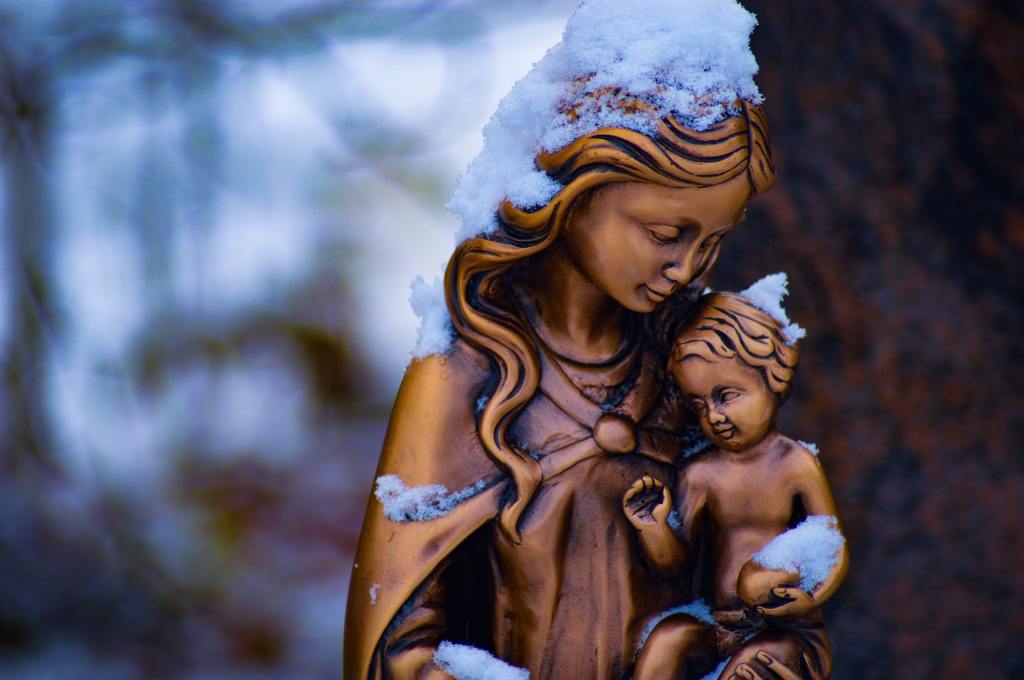
There is another Mary is often imagine, especially at Christmas, and she is not serene or accepting. When I think of Mary and the infant Jesus, I can’t help but think of how Jesus was born. I’ve watched enough women give birth to know that it’s the hardest physical work that many of them will ever experience. I imagine Mary, told that she must sleep where the animals sleep, laboring among them. This Mary cries out in desperation. She doubts her strength. She ignores the world around her to survive the agony she’s experiencing. I wonder if Joseph went to find other women to attend her. I wonder if she had anyone to remind her of her strength as she squatted, dripping with sweat, shaking and puking from the pain, to push her son into the world. Did they wipe her brow? Did they give her a sip of water? Did they let her clutch their arms until her knuckles were white?
I think about afterwards, when the shepherds came to see the baby. Was she trying to nurse him? Was he crying from hunger and frustration? Had she already delivered the afterbirth? Was she still bleeding? Was she longing for sleep? Did she lose the color in her lips when they tried to move her about too soon? Was she aching from a tear? She wouldn’t have had ice packs, or witch hazel pads, a peri-bottle, or a sitz bath, so what did they give her for the pain?
I know this Mary, because she is me. The Mary who does the messy—and gross—work of birthing the Christ child is the Mary I can easily identify with. She must labor to bring about hope. She must work, harder than she has ever worked, to bring joy. She doesn’t trust herself; she doubts the power she has been given. She focuses on the agony of the moment to keep it from overpowering her. She cries out “how much longer?” She screams, “I can’t do this.”
The desperate Mary in labor does not know the joy of the serene Mary holding the baby, just as Mary holding the baby forgets the nerve-shattering experience that allowed her to hold him. Yet she is the same woman. The truth is both images are true, held in tension with one another. I’m sure Mary doubted at times, just as I’m sure she believed. If the mother of God had doubts, then surely, I can as well.
I started a master’s program this week. I am studying religion with an emphasis in Biblical studies at Louisville Presbyterian Theological Seminary. This is something I have wanted to pursue for about 14 years, but never had the courage to apply, until this past spring. There is something transformative that happens to you when you surround yourself with people who really believe in the value that you bring. I’m thankful for the friends who encouraged me explicitly and implicitly to pursue this. Below is one of the essays I wrote as part of my application.
When I think about who God is, there is ultimately one word that comes to mind: love. Love, and God, manifests in many forms, but each way can be stripped back to this basic idea.
God loves people. From the very beginnings of the story of our faith, we see God loving and caring for people. Genesis tells us that God did not want Adam to be alone, and so God created Eve. When God calls Abram out of Ur to go to a new land, God does not put conditions on the promises, saying “I’ll give you this land if…” God hears Hagar crying out in despair and meets her in her pain. God rescues the Israelites from slavery and protects them on their journey through the wilderness. God continually forgives when the Israelites repent of their idolatry. God even entered the human story as a human, to walk beside us and show us—personally—the ways of righteousness.
Jesus shows us great love in the way he welcomed and cared for the afflicted, the oppressed, those who were ridiculed or dismissed by society, and those who were seen as outside of the Jewish society. When Jesus talks of his father in heaven, we see the picture of a just God, one who loves and accepts, who calls for humility and offers grace. Jesus loved his friends, surely, but also his enemies, healing the ear of one of the soldiers sent to arrest him, and praying for the crowd as he was dying.
God loves the earth. Scripture tells us that what God created was good. It reminds us that God cares for the sparrows just as he does for us. It teaches us the earth will praise God—yes, even the rocks will cry out—and that the trees of the field with clap their hands in joy. God cared for the animals that the Israelites used as sacrifices, by commanding merciful treatment of them through Levitical law. God created a richly beauteous world that is full of wonder. The very complexity of interconnectedness of the natural world signals to me that God loves the earth enough to spend the care it takes to put such a complex system into motion.
When I think about the ways in which God loves, I also feel the amazing power God has to transform. God is always transforming me—sometimes through pruning, and sometimes through letting me grow. Just as a gardener will dead head the rose bushes, so the flowers will keep growing, so God clips away all the unhealthy parts of me. God is a caretaker, and caretaking is at its very heart, a kind of love. It is the kind of love that wants to see a flourishing, but it is also a sacrificial kind of love. As the caretaker of my garden, I want to see my plants thrive. I take time to make sure that happens, watering them, pruning them, giving them extra fertilizer when they need it, pulling out the weeds that could choke them out. In the same way, as a caretake for my children, I put in the effort it takes to have them grow into responsible, kind, loving and self-aware adults. This takes time, patience, effort—sometimes it even takes tears. This is how I imagine God, constantly working on me, constantly beside me, guiding me, leading me, teaching me.
Jesus’s parables are full of the imagery of the garden and the farm. There are cultural reasons why he would have chosen these metaphors, but I think the genius of Jesus’ teachings is that they transcend their own time period, calling us to think about one of our most basic needs. Humans will always have a need to grow food, whether we do it industrially or individually. Jesus used imagery of the earth and how to care for it in his teachings on how God cares for us, and to show us how to live life to the fullest. This underscores the importance of God’s love for the earth at the same time it shows us God’s love for people. Pastoralists and practitioners of early agriculture would have known that to care for the farm or the garden was critical to survival. Jesus using this imagery shows how critical God’s love and care is for our own spiritual health and survival. Without it, we would surely wither, just as the vine does without proper care.
Finally, God loves me. Yes, even me. Though I might not feel like it at all times, God continually loves me. God loves me enough to open doors for me. God loves me enough to push to me to grow. God loves me enough to send me comfort when I am hurting. God loves me enough to give me opportunities to flourish and to use the gifts I have been given. God loves me enough to reveal Godself to me continuously, through my mentorships and friendships. God has loved me when I am at my worst, and God has loved me when I am at my best, and I know God will always do this. God is, ultimately, the best gardener and caretaker I know.




 The Quick and the Dead