3 So she named the Lord who spoke to her, “You are El-roi,”[b] for she said, “Have I really seen God and remained alive after seeing him?”[c] Genesis 16:13 NRSVUE
Here in the waste, the wilderness of doubt
Where thorns and dust and brambles choke the ground
There was a hum in the air around me. The expansive room was filled with other people, but I barely noticed them. I was centered on the statue in front of me. It had been placed behind a wall of glass to protect it, to separate it from the people who came to view it. It didn’t seem separated from me though, as I stood alone, wondering. The perfectly placed lighting highlighted all of Mary’s features so I could see her serene expression. For a moment, everything around me faded—the noise, the other visitors to the basilica, the tour guides giving lectures around me. For one holy moment, Mary and I were the only people in the room.
My eyes trailed over the body of the crucified Jesus laid across her lap. I felt particularly drawn to the way his hand dangled lifeless towards the earth, and the way the hand of his mother cradled him around his ribs. Michelangelo did not give him any wounds on his hands or feet, or in his side, but he didn’t need to. The agony of the crucifixion was carved into the way his body draped over Mary’s. I could almost imagine the strength of her legs, how the muscles in her arms must have strained under his weight. My eyes went back to her face, her perfectly serene face. This was not the face of a mother who had lost her son. There was a transcendent expression there, as if she had prepared herself for this. As if she always knew holding her son in this way is something she would one day do.
My ears tuned in to one of the tour groups in the basilica. The group was just a few feet ahead of me, and I could hear their guide clearly. She was explaining the debate about Mary’s youth. Why, she asked, did Michelangelo choose to make Mary so young when he carved his famous Pieta? She would have been in her forties when Jesus was killed, but Michelangelo’s Mary appears to be a young woman. The guide offered several explanations before sharing what she named to be her favorite. “This is not Mary holding the crucified Christ,” she said. “This is a statue of Mary holding the infant Jesus, imagining what her son would do for her.”
I looked at Mary’s face again, tears stinging my eyes, as I contemplated the price she paid.
I don’t claim to know how salvation actually works. I’m still unclear why Jesus died, and how his death is redemptive. I admittedly don’t like to think about his death at all, because uncertainty swirls around it when I do. The nagging questions—why?—never seem to fall away from me. Doubt is always mingling inside me, running right alongside faith. But that day, I didn’t feel any doubt. God was with me in the basilica as I contemplated his death, and I felt certain he would stay with me wherever else I went.
It was a formative spiritual experience. I can’t think of many other times in my life when I have felt as close to God as I felt that April afternoon in 2004. There are a handful of other experiences that moved me to tears or lifted the veil, but viewing the Pieta was wholly unlike them. I had traveled thousands of miles, with other teenagers whom I barely knew, to a city where I didn’t speak the language. I was truly a stranger, and yet, God transcended the borders and the barriers. God found me, exactly where I was, and it felt like God had led me there to hear the words of that tour guide as I cried over a beautiful piece of sculpture.
Even now when I think about Mary, no matter the context, my mind goes back to the face of Michelangelo’s Mary. Her absolutely pristine face, her painless expression, as if she truly believed her son was the savior of the world. As if she had prepared all her life to accept what God had planned for him. As if she was ready for it. As if she welcomed it.
Could I ever, if only for a moment, be like Mary? Just once? Please, God. Help me believe.
It’s a prayer. It’s a lament. It’s the angry words I have as I shake my fist. It’s yelling into the wind. It’s my insecurities laid bare. It’s me allowing myself to feel like I’m not enough as I am. That my faith isn’t good enough. That my faith isn’t strong because I still have doubts. That maybe next time, God won’t meet me where I am. Faith does not come easily for me, and it never has. But there has also never been a convincing reason for me to turn away from faith completely, because every time I’ve been right on the edge of unbelief, God meets me there. God will always meet me; that is my one certainty.
Yet, Mary didn’t have an easy road either. Michelangelo’s Mary, if she is holding her infant son and imaging his sacrifice, is Mary postpartum, when the hope and joy of the baby has already been realized. There was a long and difficult road she walked before she beheld him, before she wrapped him in her arms and cradled him against her chest. Before the miracle that we now call Christmas, she spent months carrying him—months that I imagine were full of wonder, but just as easily could have been filled with doubt. When she visited her cousin Elizabeth, was she hiding? When Joseph planned to divorce her, did she know? When she was laboring, did she cry out to God to end the pain?
I’ve had the honor of assisting women in birth when I work as a doula. No matter where or how a baby is born, there is always a moment when the mother says, “I can’t do this.” She is always wrong, but I would never say that to her. Instead, I gently remind her that she has all the power she needs inside of her already. I remind her that she can. I tell her that I’m watching her do it. I tell her that she must surrender to what is happening. “Don’t fight with the pain,” I say. “Let it carry you.”
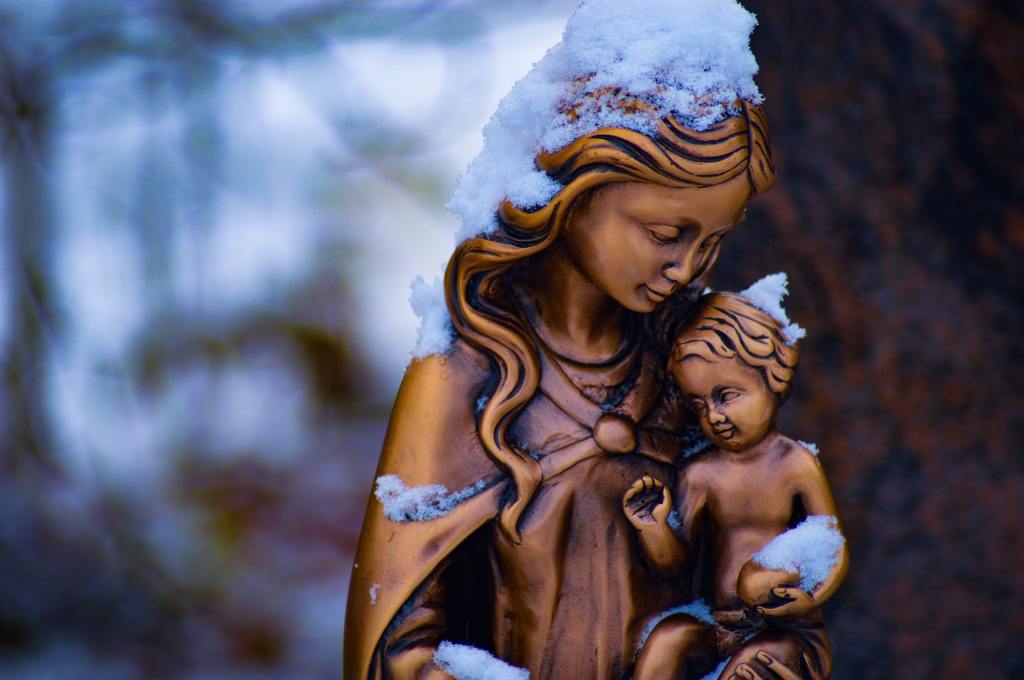
There is another Mary is often imagine, especially at Christmas, and she is not serene or accepting. When I think of Mary and the infant Jesus, I can’t help but think of how Jesus was born. I’ve watched enough women give birth to know that it’s the hardest physical work that many of them will ever experience. I imagine Mary, told that she must sleep where the animals sleep, laboring among them. This Mary cries out in desperation. She doubts her strength. She ignores the world around her to survive the agony she’s experiencing. I wonder if Joseph went to find other women to attend her. I wonder if she had anyone to remind her of her strength as she squatted, dripping with sweat, shaking and puking from the pain, to push her son into the world. Did they wipe her brow? Did they give her a sip of water? Did they let her clutch their arms until her knuckles were white?
I think about afterwards, when the shepherds came to see the baby. Was she trying to nurse him? Was he crying from hunger and frustration? Had she already delivered the afterbirth? Was she still bleeding? Was she longing for sleep? Did she lose the color in her lips when they tried to move her about too soon? Was she aching from a tear? She wouldn’t have had ice packs, or witch hazel pads, a peri-bottle, or a sitz bath, so what did they give her for the pain?
I know this Mary, because she is me. The Mary who does the messy—and gross—work of birthing the Christ child is the Mary I can easily identify with. She must labor to bring about hope. She must work, harder than she has ever worked, to bring joy. She doesn’t trust herself; she doubts the power she has been given. She focuses on the agony of the moment to keep it from overpowering her. She cries out “how much longer?” She screams, “I can’t do this.”
The desperate Mary in labor does not know the joy of the serene Mary holding the baby, just as Mary holding the baby forgets the nerve-shattering experience that allowed her to hold him. Yet she is the same woman. The truth is both images are true, held in tension with one another. I’m sure Mary doubted at times, just as I’m sure she believed. If the mother of God had doubts, then surely, I can as well.


 The Quick and the Dead