For the next few weeks, I’ll be posting short scenes from unfinished stories. Some of these scenes are part of larger works that remain unfinished. Others are a solitary, a single scene from a story that hasn’t come to me in any shape or form…yet.
The cup sat on the table before him, and he hung his face over it, willing the smoke from the candle in his hand down into its contents, to dance on the surface of the brown water it contained. The smoke glided up, not down, and he silently cursed for what felt like the hundredth time. He tried again, this time concentrated on the flame, directing it down, down down. Yes, good, this is good, he thought as he watched the way the flame dipped into the cup. The smoke began filling the vessel, but most of it escaped. He doubled his concentration, speaking to the smoke now, and smiled to himself as it started to descend, responding to his command be heavy and his plea show me what I seek.
When the smoke was dancing, swirling, hovering over the water within the cup, he blew out the flame on the taper and placed it on the table. Then he lift the cup to his face with two hands and peered into the smoke, watching how it formed shapes and pictures on the surface of the water, staining the surface of the liquid dark as ink. He smiled as he saw a girl dancing, before she was whisked away by friends, covered in a veil, presented as a bride. A slow chuckle burbled from inside him as he imagined it. He, a novice sorcerer, and her, a girl who kept the geese.
The door of the house creaked open loudly before it banged against the wall. he was so startled that his jump of surprise caused the water in the cup to splash up into his face. He could taste the dirt and the smoke in it as it ran over his lips. He blinked stupidly before looking towards the door, to see his teacher, Hargin, who was a real sorcerer, hauling in a load of firewood. He was grunting from effort as he moved towards the fire place. He spilled the load all over the floor of the house before he got to the place where the few logs that were already inside were neatly stacked. Hargin was muttering as he picked up the logs one by one, huffing and puffing as he placed them into the stack next to the hearth. Then, finally, he turned at looked right at Beagus, sitting at the table with smoke and water and shock still covering his face.
“What did you see?” Hargin asked as he stomped towards the door to close it. The man was huge; Beagus wondered why he hadn’t built a bigger house.
“The goose girl is getting married,” Beagus said.
“To who?” Hargin asked, shutting the door with more force that was probably necessary.
“Oh…” Beagus. He hadn’t thought it anyone other than him.
Hargin put his hands on his hips, and Beagus thought he couldn’t decide if he wanted to laugh or frown.
“Next time don’t use dirty water,” he said. “You can’t see as well if it’s full of dirt.”
I knew the moment that King Eadwig died. I woke in the night with a sigh escaping me, as my heart felt faint. I felt him close his eyes just as mine opened. There was no one wail for him. Not yet.
“Osburga,” I whispered. She stirred next to me. “Osburga, he’s dead.”
She didn’t respond. I slipped from beneath the blanket, stirred the fire, set a few more logs in the hearth, and pulled my shawl around my shoulders. The sight had given me the knowledge of now. The problem was not that I could not see things present. The problem was that I was too afraid to see some things at all.
I watched the fire, trying to find my way back to King Eadwig. The sight showed me him easily, now that I had seen him once. His body was still warm. I pondered how long it would be before anyone knew. A servant had recently replenished the fire. It was crackling wonderfully while his body cooled in the bed. I shivered, watching his cheeks grow gray, his lips ashen. I listened, but his body made no sound. There was no life in the room at all.
But then I heard a faint whisper. The sight showed me a woman, a nun, praying. She was on her knees beside her bed, her habit slipping back, showing her brown hair. I listened until the words she prayed filled me.
“May his days be few; may another seize his position. May his children be orphans and his wife a widow.”
An odd prayer. A curse.
Osburga stirred in the bed and I startled at the noise. The sight left me.
“Did you find her?” Osburga asked.
My gaze flew to where my teacher was, now sitting up in the bed, the blank piled in her lap. “You did know where she was.” It was almost an accusation.
She shook her head. “I knew nothing,” she said, “except that you would find her, hunched over the fire like that.”
I stood, surprise moving through me, propelling me towards the bed. “You can see the future?”
She laughed. “Sometimes,” she said. “Only when I really care to know.”
This puzzled me, and I cocked my head the way a curious dog would. “Why did you care to know where my mother was?” I asked.
Osburga’s long hair was loose around her shoulders. She brushed with her fingers, gathering it into a braid. “It is good to know who the wise women are,” she said simply.
The sight came back to me, and I saw my mother end her prayer. She pulled the habit higher, covering her hair again. She smiled to herself, a coy smile, before she rose from her knees and slipped back into the bed. I felt her pleasure. The curse had worked.
A distant scream echoed through my mind. The sight took me back to King Eadwig, who was cold now, and stiffening. The maid standing over him was yelling, and soon the room was filled with men with lanterns, crowding around him, afraid to touch him, afraid of death.
“It was her,” I realized. “That’s why he was sick.”
Osburga raised her eyebrow. “Perhaps,” she said.
I swallowed down the fear that felt like a frog climbing my throat. “Do you think, if I go to the nunnery, she’ll remember me?”
Osburga stared at me blankly, for long enough that I almost looked away. “You are a wise woman now, little witch,” she said. “She will recognize you.”
Somewhere, far away, I heard a woman whisper my name. I closed my eyes. I’m coming, mother.
I lived with Osburga until the season started to turn, and the cold set in, the mornings frosty and the evenings holding a chill that crept into my bones. I had seen my father once, his eyes understanding, even if he was sad. He knew he couldn’t protect me. Only another woman like me had a chance of doing that.
Osburga didn’t teach me anything about the sight. We gathered herbs, and dug roots and chopped ingredients for soups and potions, and sometimes a man would show up and she would send me out of the cottage for a few hours. She slept soundly at night, thought I would wake at the faintest scratch in the forest. She said I would get used to it. As the autumn stretched on, I wondered if she was right about that like she was right about nearly everything else.
“You’re too careful,” she said one wintery morning, when not even the fire could warm me. She was sipping mead from her mug, and gnawing a hunk of bread, wrapped in a huge blanket as she sat at the table. I was crouched near the hearth, warming my hands, watching the flames, listening to the fire crackle. It reminded me of the snap of the horse’s leg.
“Don’t want to get burned,” I said over my shoulder.
“I wasn’t talking about the fire,” Osburga said.
I had known that, but I was afraid of her pushing me. This was not the first time that she had commented on my timidity. “How do I conquer the fear?” I asked, wanting more. The taste of something greater was within reach, but I couldn’t quite open myself to it. It had killed my gran, and driven my mother away. Why did I want it?
“You don’t conquer the fear, little witch,” she said. The term was endearing now, after months of it rolling off her tongue. “You accept the fear, and go forth in spite of it.”
“Accept the fear,” I echoed. My hands and face were finally warm. I stood and turned by backside to the hearth. I met her gaze as I tugged my shawl tighter around me. Osburga sipped from her mug without taking her eyes from me. I felt my throat tighten, and my mouth go nearly dry as I thought about all that I had seen of my mother’s journey from home. I had learned how to see her, to follow her path from our village to the forest, and from the forest to the open wild lands, and to a churchyard where she had met a nun, and then into a nunnery. The sight had taken me with her across these years. I could see where she had been, but I still did not know where she was.
“Perhaps she is still in the convent,” I said. Osburga and I had talked about this often. She knew that it was the last thing I could see about my mother. She went with the sister into the convent. She did not wear a habit when she went to prayer. That was all that I knew. “Maybe that’s why I can’t see her. I can’t see things that are, only things that were.”
Osburga was still studying me. She took another sip from her mug. The fire was roasting my rear, so I took a step towards her. She put the mug down on the table, and took a bite of the bread in her other hand. Saying nothing as I reasoned out a problem was Osburga’s preferred method of instruction. She said nothing, so I knew I had gotten it wrong.
“Accept the fear, ” I said again. Osburga continued chewing slowly. I sighed and crossed the room to the table, sitting opposite her. She tore off a hunk of the bread and passed it to me. I bit into it and methodically chewed along with her.
“Did you know that King Eadwig is ill?” she asked me.
A test. Osburga could see what was as easily as she could see what had been. She wanted me to accept the fear to see for myself.
A shiver ran over me, one that wasn’t related to the chill in the house. It was the kind of chill that accompanied a fever. Fear shook me. A fever could kill. I swallowed the lump in my throat, waiting for what the sight would show me. I closed by eyes, slowed my breathing, and felt the fear in my belly like a stone. I focused on it, drifting down to meet it. I opened to it, and then suddenly, I saw him. King Eadwig was burning with fever, in a grand bed, nearly out of his mind with pain. There were men standing around the bed, observing, powerless to do anything for him but offer beer and wine. He was sweating, and his skin was pale, like death had already touched him. I pressed a hand to my face, feeling the fever in my own cheek.
“He’s dying,” I croaked, my throat tight with fear. It was not to be spoken. The King was anointed by God. To speak of his death was to speak a curse.
I opened my eyes, peeling myself away from the vision that the sight had given me. Osburga was smiling at me. “Do you think they will accuse a woman of bewitching him?” she asked.
I knew nothing about King Eadwig, except that Cynewulf was his ealdorman, and that Cynewulf had ruined my mother’s life. “If there is a woman near enough to him that has offended the wrong man, I suppose they will.”
This seemed to please Osburga. She finished eating her bread and picked up the mead mug again. She took another drink, her eyes shifting from the golden liquid to me. The blanket she wore tumbled off her shoulder, and she tugged it up around herself again with her free hand. I shivered, wishing I had stayed near the fire. I munched the part of the loaf she had handed me and waited for whatever it was that she was turning over in her thoughts to escape from her mouth.
“Are you afraid to learn the truth about your mother?” she asked.
It made me wonder if she had known all this time, and not told me. I pushed away the thought. You could go looking for an answer, surely, but that didn’t mean that the sight would give you one. “I am afraid that when I find her, she will be dead.”
Osburga nodded. “Use that fear,” she said. She finished the mead and placed the empty mug on the table between us. I looked into the empty vessel, trying not to imagine it as a metaphor for what I would see when I finally found my mother.
Osburga wasted no time with me. As soon as the offer to teach me bewitching left her lips, a powerful wind blew through my spirit. I gasped at its bite, the chill of it snaking along my limbs. But I held Osburga’s eyes until it passed. She seemed pleased with my tolerance and my stoicism. “Good,” she said. “You can feel the power and already have a respect for it.” She paused, tilting her head as she considered me more thoroughly. Her gaze was a test, though I didn’t understand what she was testing. My spirit was thrilled by her gaze, though I did not understand why. She smiled at me broadly. “And you have respect for yourself as well,” she said.
She rose from her place at the table paced to her door. She flung open the door to the outside air. “Come,” she said without looking at me before she disappeared outside.
I followed. There was no other choice.
We went on deep trails through the forest, going deeper and deeper until I had lost all sense of direction. Osburga walked two paces ahead. I imagined how we looked from afar- women determinedly marching through the woods, holding up their skirts to avoid snags and snares in the fabric as we passed by thorn and bur and branch. Two women, headed somewhere no one but wise women would go. We moved along without speaking, until finally Osburga came to halt ahead of me.
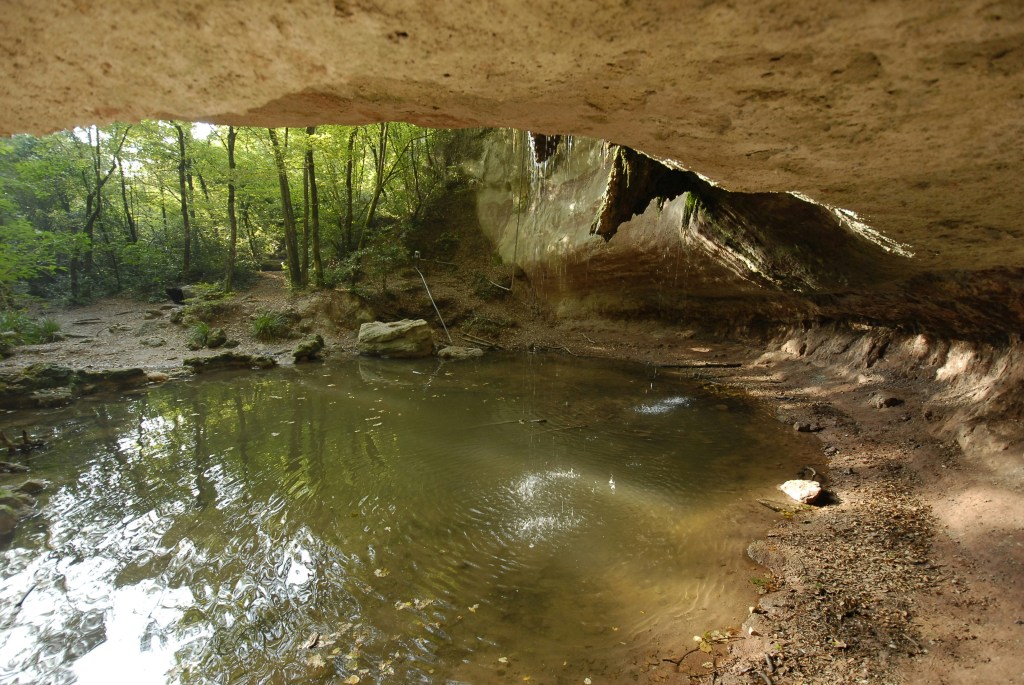
We were standing at the top of a small hill, and at the bottom of the hill ran a stream. Rocks littered the path down the hill and the stream bed. My eyes followed the flow of the water to an entrance to a cave. My heart leapt to my throat. “Are we going in there?” I asked, the dread settling in my bones.
“In the cave?” Osburga laughed. “No. No one can go into that cave.” She laughed to herself. “We’re going into the water.” Her laughter had a twinkling quality, like starlight. She moved down the hill and I followed her to the stream, crunching last year’s leaves underfoot. I followed her right up to the bank of the stream. I didn’t know how she deftly avoided slipping on the mossy stones. She was so light on her toes, while I could barely find my balance.
The stream pooled at the mouth of the cave before it ran underground. The pool was deeper than it looked from at the top of the hill. I peered into the depth, feeling the swirling power in the water.
“What do you see?” she asked.
I focused my eyes on the rocks at the bottom of the pool, which changed colors and shape as I stared. My vision swam with things of the past as I watched the rocks morph into the face of my mother, and the horse that carried Ealdred, that threw him to the ground when he tripped, the face of Cynewulf, leering in the dark of the woods. And there was my gran too, whom I had never met, hanging in the tree, as my mother watched her house burn. By grandad took her by the hand and led her away, swords pointed at their backs as they left the only home they’d ever know. I could see a long line of women, all the way back through the ages, each one’s face rise to the surface as the pool as they looked me in the eyes, smiling with magic and guile. No, stop it. I pleaded with them to go away, but I could not more stop the sight than I could stop my breath.
Osburga touched my shoulder, and the visions broke. I gasped, tears filling my eyes. I gulped in air as if I had been drowning. “I can only see into the past,” I cried, tears streaming down my hot cheeks. The stones at the bottom of the pool were just stones again. I wiped the tears from my face with the back of my hand. “I can’t see anything about now, or about the future.”
“Oh, it takes a great power to see the future, little witch,” Osburga said.
I whirled on her, feeling hot with anger at her words. “Goda said you could help me. But you’ve only shown me what I’ve seen before.”
Osburga crinkled her nose at me, as if I smelled like something she didn’t want in her house. “I’ve shown you nothing, Eadgyth.”
I calmed, her flat pronouncement of the truth registering as a indisputable fact. My anger cooled and I bowed my head. I did not want to meet her eyes. The wind rustled the leaves overhead, and for a moment, I thought I heard a call on the wind. It sounded almost like my name, but I pushed away the ridiculous thought before it could take root.
“Eadgyth,” Osburga said tenderly. She took my face in her hands, turning my eyes upward along with my chin. “To find your mother, you must first find yourself.”
My head felt as if I had drunk too much mead at the Easter feast. I pushed away the thoughts that threatened to creep across me. You’re weak. You’re not worthy of the power. You will never see anything of value. All lies. Told by the great liar, whom the priests called the Devil. But they called my mother and my gran of the Devil too. Why should I believe that the Devil didn’t speak to me as well?
Osburga frowned. It was as if she sense the thought that intruded into my skull. “You are thinking that this is not a gift?” she asked. “That it is too hard?”
I realized then that she didn’t know my thoughts; she had only guessed, probably based on what she had experienced when she had awakened to the powers she had. “They will call me names. They will cast me away, as they did my mother. They might hang me in a tree, as they did to my gran.”
Osburga dropped her hands from my face, only to take up stroking my hair. “Ah, they might, little witch,” she said. “Better then, that you stay with me.”
And the sight took me at her words. I saw the friendship blossom between us, and how she felt already like a replacement for the mother I had lost. I reached for her, wrapping my arms around her waist, and falling into her. She tucked my head against her shoulder, shushing sweetly as I let silent tears flow.
“I will help you,” Osburga whispered. “You will need protection from those who seek to do you harm.”
I shut out the image of the burning house, and the screaming horse that would not leave me. I looked for my mother among the images, but she was nowhere to be seen.
I peered through the bracken, staring at the smoke coming from the little cottage just deep enough into the woods that you couldn’t see it from the clearing. The mossy, rich smell of earth and wet leaves filled my nostrils as I crouched behind the fallen tree, mustering the courage to creep forward. I knew the woman inside the house wasn’t dangerous. My cousin had seen to her plenty of times. Goda came for love potions but I had come for something harder to find: answers.
My legs were cramped from crouching for so long, and the damp from the leaves was starting to take to the hem of my skirts. I rose unsteadily, clenching and unclenching my fist a few times to still my nerves. Then, I hopped over the fallen tree, and crunched my way through the underbrush to the front door of the house. Before I could talk myself out of it, I knocked softly three times. Goda said that Osburga, the wise woman, would answer from within before she opened the door. You had to tell her what you wanted first. If she didn’t like your reason for coming, she wouldn’t let you inside.
“Who comes and why?” Osburga called out from inside the cottage. I could hear the faint sound of movement towards the door. I closed my eyes, imagining her on the other side of the wooden slats between us, pressing her ear to the door just as I was.
“It’s Eadgyth,” I said shakily, “and I want to know what happened to my mother.”
The door creaked open slowly, and the woman who stood in the doorway was not as I had imagined from Goda’s description of her. She was tall, and she looked much younger than I had thought she would. Her hair was a rich brown that hung in waves to her waist. She was wearing a simple brown dress and an apron. Her eyes were kind, but there was also wariness there. I could feel the hurts she carried, for just a moment, a flash of the sight that had me seek her, to ask for her help in seeking out my mother. I shut my eyes against the vision that was taking me- a woman hanging in a tree, and a fire that consumed the place where she had lived, a horse screaming in pain, and a man who walked with a limp. I gasped at the clarity of it, but shook it away from me as I searched the eyes of Osburga, waiting for her to invite me in.
“What do you need me for if you have the sight like that, little witch?” she asked.
The dreaded word on her tongue stilled my heart. It was one of the only things I remembered of my mother. Witch. That’s what my father said she was. That’s all she was remembered for. “Please,” I said, not knowing what else to say. “I don’t know how to control it, and I know my mother would, but I don’t know where she is.”
Osburga opened the door wider, and stepped out of the door frame, to allow me room to pass. “You don’t control the sight. You learn how to let it not control you.”
I hesitated at the threshold, shifting my weight from one foot to the other. “Can you teach me?” I asked, tentative as a mouse, my voice barely more than a whisper. As if in response, the wind rushed through the trees around us, rustling the leaves in an eerie way that made my skin crawl. My mouth went dry, as the feeling of power moved through me. I shut my eyes again, stilling it, willing it away.
When I opened my eyes, Osburga was still standing before me, her hand resting on the door as if she had half a mind to close it on me. We stared at one another for a time before she finally asked, “Well, are you coming in, or not?”
I dipped my head in a bow to her, and ducked through the doorway into the dim cottage. She had a fire going in the hearth. Herbs were drying, hung from the ceiling along the walls. She had a stack of books, which astounded me. Only the monks had books. She smiled at me, as if she knew what I was thinking. She gestured to the table, shoved against the wall, next to a bed that looked too big, too grand, for a single woman alone in the woods. She had fabric over the windows, rather than shutters. I wondered how she kept out the chill.
I sat, and Osburga joined me. “Now, little witch,” she said. “Tell me why you’ve come.”
“I told you. I need help finding my mother…”
She interrupted. “You also said you want to learn how to control the sight.” She raised at eyebrow at me.
I swallowed hard as my hands began to sweat. This was a test. I held her eyes as she held mine. There was a spark of amusement there. She laughed after a moment, a short, pleasant sound that reminded me of an owl. I wondered what she would look like as an owl. A wise one, haunting the woods. It seemed fitting.
“Eadgyth,” she said slowly, as if she was savoring the sound and the feel of my name in her mouth, “you are a strange little witch.”
“I’m not a witch,” I protested. I thought I did not sound confident at all. “At least, I don’t want to be a witch.”
“Neither did I. But we don’t get to choose these things, do we?” Osburga reached for my hand, and she stroked my palm with her finger. She hands were weathered, the nails caked with earth. Her touch was light and soft. A smell of honeysuckle filled the air. I sighed with pleasure. Osburga smiled back at me, lovingly, like a proud mother. Like I had done something wonderful, though I wasn’t even sure I had done anything at all.
“How long have you had the powers?” she asked. She withdrew her touch from me, and the honeysuckles faded along with the pleasure.
Fear replaced it, a tightening across my chest and in my throat that threatened to have me squeaking out answers to her again. “It awakened in me before my mother disappeared… I was four, maybe five.”
Osburga nodded. She looked thoughtful, eyeing me as if to determine how old I was now. Would she know my age as she knew my name? Her eyes wandered to the hanging herbs. “Your mother was Wulfrun,” she said, her tone inquisitive.
“You knew her?” I asked.
“I know of her,” Osburga said. “They say she cursed the son of King Eadwig’s favorite ealdormen.”
I nodded, confirming the story that had propagated like gnats. “That is what is said of her.”
Osburga wrapped her knuckles across the table three times. “Tell me what really happened, little witch,” she said.
I wished she would stop calling me that, but as the sight took me, I knew I couldn’t argue. “Lord Cynewulf wanted her,” I said. The vision of my mother with Cynewulf was shadowy, the darkness of the forest at night, obscuring what had happened. I had seen this many times before, and the memory of it, though not entirely mine, lived inside me. I let the sight take me further into the dream. “She was gathering in the dark… something for her medicines. She did it at night so no one would see. Except he was there that night. And his son was there too.” I watched as Cynewulf and his son, Ealdred, confronted her, tried to persuade her, offered to pay her. She refused, and she had run from them to save herself from their violence. I felt the sweat begin to soak through the armpits of my shift as my heart raced. My mouth felt dry as a old bark.
Osburga touched my hand. I gasped in surprise and the sight left me. She leaned her face towards me, her eyes searching for something within, some kindred flame to which she was drawn. I could feel it too, our shared nature, as if we had been wrapped together in the same package once. There was a similar color to her soul, and I could smell on her the power that took hold of me sometimes. “I know Cynewulf, ” she said, her words like iron. “And his son would have been just like him, except for that fall from his horse.”
The horse had tripped over a stone. I heard the horse scream while I was darning socks. But the horse was not near at all. I saw my mother react to it too, dropping her knitting. I shook with fear, wondering, later, as I watched Cynewulf’s men carry Ealdred into the village on a litter, how I had heard it happen. Ealdred’s leg was twisted, he was screaming in pain. His cry was like the scream of his horse. Even then, the sight had me, even as young as I was. I had seen the horse go down, saw Ealdred fly from the saddle. The snap of his leg in the vision sent a shiver through me. His howling woke the dead. My mother had heard it just as I had heard it. I swallowed down the taste of his marrow that filled my mouth as I remembered. “They blamed by mother. Said that she had bewitched him.”
“Did she?” Osburga asked, her eyes now sparkling with mischief.
“Of course she didn’t,” I said, but the protest was weak, and grew weaker as I watched Osburga’s smile grow. “What do you know?” I asked.
“I know that if you are accused of bewitching, it usually means you have the power to do it.”
A shiver ran over me, as hair of my arms stood on end. “And… how would I know if I have the power to do it?” The question slid from me before I knew I was asking it.
The White Stone, a short story I published on The Quick and the Dead in 2022 has been lengthened into a novel, and is now live on Kickstarter. The campaign runs until October 31 at 6 pm EDT. If you enjoyed reading The White Stone and the companion stories published on this blog, I encourage you to check out the full novel. Use the the embedded link below to make a contribution to the campaign and select your reward- either a hardcover or softcover version of the book. Issa Brown has beautifully illustrated 14 characters from the novel which will be included in color in every print copy. My pie-in-sky stretch goal is to narrate an audiobook of this story along with two of my friends.
Thank you for reading my work. I hope you enjoy The White Stone.
I have had the pleasure over the past few years of creating the flavor for the world of the game line Never Going Home (publisher Wet Ink Games) through my short fiction and inventing historical artifacts. This year, we wanted to stretch the magic of the game a little further, and I had to the idea to write out the pages of a mysterious spell book that is featured in several of the stories I have written for the line. My goal was to have the reader ask themselves, “what am I reading?” I have heard that I hit the nail on the head.
Locked in the book of secrets, we bear witness—
Nature leads us into the eternal tree.
When the whisper comes, climb the tree to reach the barren star.
The old gods and new gods and dead ones are born in the depths.
Come, follow the sound of the water that falls from the darkness.
Bring with you a lamp of your enemy, the hair of your familiar, the skin from your first wound.
Be silent in the presence and it will show you how to unfold your wings.
Climb, climb high.
Climb the eternal tree.
To seek the blood of the newest lover, be like the honey that drips from your tongue.
In a caress like dreaming, you will encircle the branches
Each tendril a reaching finger that stirs your memory.
Be bold. Be silent. String up your demons and press them forward into the fire.
The new gods will burn you when you break the spear.
Five cuts along the stone
Five strokes painted in blood
Five kisses, dampened with death
Five long sighs. Climb.
The klumskaag will find you when you close your other eye
To summon it, trim the light from your mind.
Its wings will carry you to the source of the power
Where the other eyes will see your whole self,
The glamling, the orobing, the guldenshafen
All naked with power.
To take it as your own, bring your outer thoughts inwards
And call the name of the ancient mother.
Then open your eyes and drink the darkened sunrise.
A prayer for binding:
Bring the head of the oldest goat to the center
Fill the skull with vinegar and dust
Silence the thoughts that disturb the fear
Whisper to the god of your choosing, old or new
Then bring the skull to your lips- three sips
This will bring you closer to the star.
These six words will let you forget:
Daag glash naag abaat glaag blan
Use sparingly.
We take the blood of the ones who never lived
Bring it back to the circle, enfold it into the fire
The barren star brings life to them
The deep sings the songs of their birthing.
The ancient mothers watch with wonder
As we work this power, this magic.
They climb into the great tree. The eternal tree. We climb.
To unfold yourself, first prick your finger
Then let the pain carry you forward.
Press the bleeding tip to the wood of the tree
Light the fire at your feet and dance.
We have learned how to evade death by becoming it. It takes practice.
Sometimes you die before you can fully learn. Take care when learning.
For a wish that walks:
Find a rider, one who brings bad news. Take a hair from the horse’s tail, store it in oil for seven days. Burn the oil in your enemy’s lamp on the morning of the eighth day. Then walk in a circle four times around the flame without turning your face from the fire. Wish for the things you want, invoking the old gods and new gods as you see fit. Blow out the flame and drink the oil.
Three odd figures will come from the tree when the world is at its end.
The first will bring the fire, the second will bring the water, the third will bring the darkness.
Befriend them and they will let you climb the eternal tree.
The streaks of light will come when the tree splits
From the tear, a terror never known before.
It will draw itself from the wounded tree, flowing like poison across the land.
It feeds on fear and apathy, disease and death.
When it is finished feeding, it will leave dry husks and return from whence it came.
We will follow it to the barren star.
We will climb the eternal tree.
To feed a fever, first make a slash across the roots of the tree
Lean your face to the ground, press your lips to the earth
Taste the iron of the soil, the blood that was spilled in the dirt.
Whisper the words you learned from the gafklaagun
Your lips will taste like sweat if it has worked.
Deep in the pit the ancient mothers sing
They bring new souls from the fire
They climb the eternal tree.
When the tree splits they will fall to the earth.
They will feed on us, and we will fear them.
They will feed on us, and we will love them.
If the whispers stop it will be too late for you.
The fulfuhra has already cut you from the branch.
Your leaves will wither and there will be no more roots.
If the whispers stop then you will know
That you have been pruned from the eternal tree.
We bear witness—we have seen the ancient mothers.
In the roots of the eternal tree they brew their poisons
We go from branch to branch, they remain firmly set.
Without them, there is no tree, no roots, no life.
We bear witness—the ancient mothers give us life.
To call a new god to life, first make a circle of clay
Cross the circle with two lines of chalk
At the center lay a wreath of wax, preferably with honey.
Light a fire outside the circle, then name the one you wish to birth.
The ancient mothers will hear you, but they may not intervene.
If the fulfuhra intercedes for you, then you will taste ash in your mouth.
You will know that the birth has begun when you taste blood.
Lift the wreath of wax, break off a piece and eat it. Throw the rest into the fire.
Then sleep for three days at the center of the circle.
When you awaken, the new god will be born.
If you feel weakened by the whispers it is your own doing.
Bring the fur from a white wolf and offer it at the table.
The old gods will take it as a sign of strength and wipe away your weariness.
Be careful not to do this often, or else the new gods will throw you into the fire
Where you will become like the dead ones.
Then you will belong to the ancient mothers
And they will send you back through the eternal tree
Astrid watched from the shadows near the house as her father and Sigmund stacked the wood for the bonfire. Aelric’s chain flashed in the fire light of the torch she held. Ljót was at his side, her arms snaked around his waist. Astrid smiled to herself. It was a good match. He would be happy with her. She watched the dancing and the fiddling from the darkness, just like when her eldest brother was chained, and just like that night, she also watched her cousin Lodvik peel away from the festivities. She moved behind him, quiet as the night, catching him just as he was stepping into the lane at the front of the farmhouse.
“Going back to your woman?” she asked. Eylaug had delivered the twin girls. They were not thriving. Hrist had mixed several medicines for them, but nothing seemed to help. Eylaug did not have enough milk.
Lodvik spun on his heel, his surprise at being addressed evident on his face. But he frowned when he saw it was her. She felt her frown deepening too. “I don’t know. It’s not like I want to be there either,” he said.
“Why has she not chained you?” Astrid asked.
Lodvik looked at her like he couldn’t believe that she didn’t know the answer already. “Don’t you witches know everything?”
She had decided not to correct anyone when they called her witch. They would call her one behind her back anyway. “Because you didn’t give her boys?”
He shrugged. “It is not a happy match, Astrid. I do not care.”
She let her revulsion settle before she spoke again. “You should have come to me first Lodvik.”
“I know,” Lodvik said.
“Remember that, cousin,” she said, “And next time, trust me.”
He looked at his feet, his expression darkening. She nearly choked on the shame he felt. “I will trust you, Astrid,” he managed to say.
In the distance, she could feel Edda, full of power, full of love for Hrothgar. Astrid wondered if the other Bairns could feel her love for her brothers and her cousins through the wild magic. It had never occurred to her to ask until she had felt Edda’s love sliding towards her on the waves of the power.
She turned her attention back to Lodvik. “Ask Helga to help Eylaug,” she said.
He sneered, but at her stern frown, he softened. “Will it help?”
Astrid laughed. “Did you not know that Helga nurses babies for women who have trouble?”
Lodvik’s jaw dropped. “She does?!”
Astrid nodded. “Strip away all the wild magic, Lodvik, and we are just ordinary women,” she said.
“Ordinary women,” he echoed. Then he laughed. “Goodnight, Astrid,” he said.
She watched him walk down the hill, his form melding into the night. But the fear he had felt just a moment before was gone. It had been replaced with hope. It called back to her as he moved away. She smiled to herself and went back to Aelric’s celebration.
She knew it was a dream when she saw the Skuld smile—a pretty smile, not her typical sad, boney smile, stiff and sugared with regret. No, this smile she was given was one of pride, without any accompanying guilt or grief. A warm smile. A smile that illuminated all her dark places.
“You did it, Astrid,” she said, her voice singing like the rain.
Astrid was at complete peace, drifting like a hawk on the breeze. “I did?” she asked.
“Of course you did,” the Skuld said. Now she sounded watery, and the smile wavered before the woods around them went dark.
The voice, the spirit, that had been calling her sounded clear. Protect the boys!
“Protect the boys, Astrid,” the Skuld said, her smile now just a flash in the dark.
Astrid woke in a cold sweat, her heart racing. Spirit dreams did not typically come to her, but how could it have been anything else? She steadied her breathing, pressing her hand to her chest, tuning to the rhythm inside her. Thud-thud. Thud-thud. Thud-thud. It slowed as she exhaled, a long release. She let the tension flow from her body. She opened her eyes, and shivered in the morning air.
Protect the boys. She wondered how.
There was a knock at her door. “Astrid?” Sigmund called from the other side.
“Come,” she said. She had slept in her dress, too tired to remove it. She swung her feet to the floor.
Sigmund opened the door slowly, peering in through the crack before he opened it fully. “We heard you calling,” he said.
“I was asleep,” she explained. She had a habit of talking in her sleep. The whole house was used to it.
Sigmund nodded, though his forehead was creased in worry. “You sounded…” He searched for words. “You sounded afraid, Astrid.”
She wrestled with how much to tell him, but in the end decided she couldn’t tell him any of it. She didn’t understand what was happening herself. She didn’t think she could explain it to anyone else. “I’m fine, Sigmund. Just a bad dream.”
He didn’t move. He didn’t nod. He shut her door, sealing them inside and came to sit on the bed next to her. He offered his hand to her, and she took it, though she frowned in suspicion before she did. They sat together in silence for a moment before he said, “You said you were almost carried off?”
“Oh,” she said, trying to dismiss any of his concern with a slight laugh. “Yes, I…we did a hard task, and it…well, I wasn’t carried off.” She smiled. “Still here for you to worry over,” she said. She squeezed his hand.
But Sigmund was not smiling, nor was he charmed by her dismissal of the situation’s seriousness. “What were you doing?” he asked. “You’ve never come home looking like that.”
She stiffened. “What do you know about Lodvik and Eylaug?” she asked.
Now he stiffened, and pulled his hand away from hers, rubbing his palms down his pantlegs. “Aelric said he put a babe in her belly.” His eyes met hers, looking for confirmation. “It’s true?” he asked.
“You know the house where they say this wild magic lives?” He nodded. “We took Eylaug there yesterday, and we…looked inside her. At the babies.”
“Babies?” Sigmund repeated, his face dropping in surprise.
She nodded. “Girls.” Astrid sighed, and rubbed her forehead, feeling emptied of all her strength. “I almost was carried away looking at girls.” She could not keep the sneer from crawling across her face.
Sigmund seemed to shrink away from her. “I did not know you could do such a thing,” he said, awe and terror mixed up in his words.
“It’s not worth it to try,” Astrid said. “It took all five of us, and what did we gain from it?” She scoffed, then closed her eyes, centering herself so her anger would not catch up to her. “We leveled the house,” she said.
“You what?” Sigmund asked, breathy with disbelief.
“To prevent stories from spreading,” she said. “That place will not help us make more boys, Sigmund. It was a false hope.”
He swallowed down a question that was on his lips, taking a moment to think before he spoke. “Is there any real hope, Astrid?”
The spirits chattered. She closed her eyes, listening to the arguing. One of the voices was chanting softly to her. Edda. It’s Edda.
She smiled to herself before opening her eyes. “There is real hope, Sigmund,” she said, allowing a slight smile to part her lips. The spirits chattered around her. Protect the boys! She listened to the call, thinking of her white stone. She closed her eyes, meditating on the words, drowning in the arguing of the spirits. Someone was screaming, long, devastated, agonized screams of terror. Who are you? She asked into the misty realm where the spirits dwelled. The screaming stopped, then the voice repeated the familiar instructions. Protect the boys! The same voice?
Astrid opened her eyes, and her brother was eyeing her cautiously. “What do you know Astrid?” he asked softly.
The wild magic was not for him, and she was always careful not to reveal what had been revealed to her. Unless he asked for a reading, she would not tell him what she suspected. “I know many things that I would not know without the spirits to tell me,” she said, ignoring his question by giving him an indirect answer.
Sigmund sighed. “Astrid…” he began, but she turned her face away from him, distracted by Sif’s swirling power. She was far away, accompanied by a deep groaning that sounded like the earth swallowing her. Astrid concentrated, pulled towards the power, towards the emotions that were not her own. She stood, hair prickling on the back of her neck.
“What is it?” Sigmund asked, standing as quickly as she had.
She shook her head, then, forgetting Sigmund, allowed herself to be hooked by the call, pulled out of the house and down the street towards whatever trouble had enclosed around Sif.
The streets were empty, which Astrid thought was unusual. She felt an unnatural sensation in the air as she passed the houses, moving towards the center of Soledge. She moved with purpose, slowly, feeling each of Sif’s threads growing taut with tension. Astrid paused momentarily as she passed the apothecary. She could feel the girl, Edda, slippery with love for her man, bouncing from uncertainty to clarity. She lingered too long. Edda reached out, felt her presence. Astrid melted away quickly, not wanting a distraction.
But a distraction found her anyway. At the end of the lane, just as the dirt road disappeared into the grass and old rock that led to the edge of the woods, Aelric was standing with his hands on his hips. He looked stormy, his face overcast with fatigue and fear. Fear. There was always fear.
“What are you doing?” she asked her brother, approaching at a snail’s pace.
Aelric grimaced, rubbing a hand over his mouth to wipe away the expression. “I was…” His eyes shifted away from her. “Astrid, can you…” Whatever it was, he didn’t want to say it. She could feel Sif in the woods, filling with wild magic. The groaning she had heard she now recognized as Aelric’s fears. She stepped nearer to him, closed her palms over his arms. Her touch drew his gaze back to her.
“Aelric,” she said tenderly, soft as air. “What are you doing out here?”
“I couldn’t sleep—listening to Sigmund and Magnhild…” He seemed embarrassed, but she nodded to indicate he didn’t need to explain any further. “I feel sick, Astrid,” he confessed as he brought his face closer to hers. “Like a future is coming for me that I don’t want.”
Lodvik had also expressed this fear—the fear that his life would be chosen for him, without his say. “What do you want, Aelric?” she asked.
“I want to be rid of my fear,” he said. He dropped his eyes, frowning. “I don’t want to be a tool, to used by the spirits and women just to get what they want.”
Astrid remembered the feelings of fear that had taken her when the spirits first began to call her. “I know what you mean,” she said.
Aelric grew angrier, which surprised her. She withdrew her touch, as he spun away, pacing back and forth before her with his hand to his temple. He was thinking furiously, his emotions spinning in a chaotic swirl. She sucked in her breath, resisting the dizziness they brought.
“You don’t know, Astrid!” he yelled, though he didn’t look at her. “You and the other witches think you know, but you don’t know anything!”
For once she didn’t correct him about his choice of descriptor for her and her sisters. “What do you want, Aelric?” she asked again.
He stopped pacing, and looked at her hard, his eyes a sharpened blade of fear. “Sigmund told me to have you read the runes,” he said, deflating as the words left him.
“Is that what you want?” she asked tenderly, reaching for him again.
He pulled his hands away so she couldn’t touch him. “It doesn’t matter what men want, Astrid.”
The words pierced her, brought a flood of tears to her eyes. “There is one who will be called to make it better for you,” she confessed, surprised at the free flowing admission.
He frowned, but his anger cooled. “Who?” She should not have told him anything at all, so she kept her mouth shut. He scoffed, and waved a hand between them, dismissing the conversation. “It doesn’t matter,” he said.
Astrid could feel Sif moving towards them. “Do you want me to the read the runes for you?” she asked.
“And what would you ask?” Aelric said.
She shrugged. “I’ll ask whatever you want to know,” she said.
He considered her for so long that she felt she would grow roots. “Okay,” he finally said, the word a sigh of resignation. “Ask if my sister can find me someone who won’t care so much about what’s between a baby’s legs.”
She swallowed her surprise, blinking back any questions that might have crept into her eyes. She nodded, then retrieved the runes stones from her pouch. She called the wild magic, let it slide through her, twirl around her. She felt warm in its smooth embrace. It filled her, and her she knew the moment that her hair and eyes lost all color, because Aelric took a step back from her. She raised one of the blank white stones to her lips, kissing the smooth surface. She cast the stones to the ground.
The woman. The river. The roots. The grain. She listened to the chatter of the spirits. She knows the land…she farms the lands…she will take him…his chain will be light…She smiled. She did not know the woman well, but a smile crept over her face at the imagined pairing.
“Well?” Aelric asked, his tone a mix of curiosity and suspicion.
“Ljót,” Astrid said, the name sliding easily off her tongue.
Aelric raised an eyebrow. “Why her?”
“Boys and girls both can tend to farms?” she offered.
Her brother nodded, thinking it over. “The runes don’t lie?” he asked, uncertainty creeping into his voice.
Astrid nodded. “If it’s in the runes, it’s true,” she said, repeating the often cited reason for why one should believe the message from a reading.
Aelric was about to ask her another question when Astrid’s attention was drawn to Sif coming out of the woods behind him. Her brother noticed, and sucked in his breath when he saw the other Bairn. “I’ll see you at home,” he said, as he almost ran from the scene. Astrid watched Sif’s approach. She was ecstatic with power—too much, Astrid thought. She looked unearthly, like the Skuld.
“Sif,” Astrid called, reaching out her hands to her sister.
Sif released some of the wild magic. Her eyes were wild with delight. “She’s ready,” she whispered, her face close to Astrid’s.
“Protect the boys,” Astrid whispered compulsively. Sif did not seem to understand what she meant. Astrid didn’t know why she had said it. It had come out of her almost on its own. “I’ll go with you,” she said.
Sif led the way.
The man, Hrothgar, was leaving the house as Sif and Astrid approached. She could feel Freya moving towards them. Hrothgar paused on the doorstep, scowling in their direction. He hadn’t yet shut the door. “Are you here for me?” he called. Fear. Astrid could taste it in the air.
Sif shook her head. “Edda,” she said.
She appeared in the doorway as if summoned. Astrid noticed her unkempt hair, the way her clothes seemed to move on their own. She was holding wild magic, but she likely was not aware that’s what she did. “What do you want?” she asked. She sounded like thorns, like a crashing stone from the cliff, like ice.
“You,” Sif said.
Freya was behind her, and Astrid took a step to the side to let her slide between her sisters. Freya too was delighted. The threads of wild magic linking them passed her emotions to Astrid. Sif ran her tongue over her bottom lip, and Freya pressed a hand to her chest, stilling her heart. Astrid let the heightened emotions of the moment carry her forward. She took one step, but paused as she watched Edda and Hrothgar draw away from her.
“You’ve heard the spirits,” she said.
Hrothgar whirled around, staring at his woman with confusion and panic. Astrid tasted the salt of his dread. “Have you?” he asked.
Edda’s eyes beaded with tears. She nodded. “I don’t want to…” she began.
“You cannot say no,” Freya said. She took a step forward. “It takes more than a man to keep you from the spirits.”
Hrothgar blazed with anger. He shouted at Freya. “Why can’t you just leave us alone? Call someone else!” The echo of his bellows filled the corridor.
“We don’t choose. The spirits choose,” Astrid said calmly. She took another step forward. Hrothgar recoiled further, nearly retreating into the house.
“Choose someone else,” he said.
But from over his shoulder, Edda caught her eye. She was swirling with anticipation, with curiosity, with fear. They were always afraid. “We’ll teach you. You will be safe,” Astrid said.
Edda looked almost willing, but then frowned, and clutched Hrothgar’s arm. “Not if I lose Hrothgar,” she said. “Nothing is worth that.”
“He’s a man, Edda,” Sif said, laughing. “He’s only good for one thing.”
Astrid knew it was the wrong thing to say before Sif even finished. “Go away,” Edda said. “Leave us alone!”
“The spirits will keep calling you,” Freya said. “And we will keep waiting for you.”
Hrothgar pushed Edda back into the house, shutting them inside. The click of the door’s latch seemed eternally final. Astrid did not think it would be easy to convince her. Perhaps her no would be the end of the call, just as Skogul’s had been.
Freya and Sif were smiling though. “She thinks she knows better than us,” Sif said.
Freya’s laugh was sinister. “She will learn,” she said.
Astrid swallowed the fear. There was always fear. Protect the boys, she thought, though she wasn’t sure if it was directed to herself, or to Edda. She thought of Asmund, dipping his finger in the puddle as she had, trying to touch the wild magic, and she had a sudden revelation. It shot through her like lightning. The spirit calling for her to protect the boys had not been calling her. It had been calling Edda.
“Are your sure?” Freya asked, intruding into her thoughts, as if she knew them.
Astrid slowly turned her head to regard her sister. “Whatever needs to happen to restore balance, it will begin with her,” Astrid said, nodding her head towards the house.
The three Bairns all turned their eyes, just in time to see Edda drop the curtain and vanish from the window.
When Astrid woke, she was in the grove. Her body was cool and stiff. She sat up, trailing her hand across the dew gathered on her skirt. Mist rolled over the ground. The Skuld was not with her.
She had come to the grove after Lodvik stormed away from her. It pulled her in, the spirits calling and chattering. She didn’t try to sort out their bickering. She followed the threads of the wild magic. It was a beacon summoning her. She never asked why, she simply obeyed.
In the grove, she and the Skuld had read the bones late into the night. The spirits had argued, screaming about boys and men, screaming about new Bairns, screaming for the sake of screaming. The bones told stories of what might be, stories of what could be, stories of what would be if all the right choices were made. Some of the futures did not please her. Some delighted her. Not a single one did not fill her with dread.
Everything would change. Everything. And soon.
“The woman that Freya has been watching,” the Skuld began.
“Edda,” Astrid said, looking out across the bones that foretold change and upheaval.
“She is ready,” the Skuld said.
“She has a man,” Astrid said. “It’s always harder when they have a man.”
The Skuld smiled. “He will not keep her from us,” she said.
Astrid looked out across the bones. She realized the Skuld was right. She had not seen it before. “Good,” she said. “I think we need her. We need her almost as much as we need boys.”
The Skuld took her hands in her own, staring deep into her eyes. “And those boys will need you, Astrid.”
Astrid nodded, thinking of the name on her white stone. Her true name. “I had thought I knew what my true name was when it was given to me,” she said. “But now I see that it goes deeper than what I thought.”
“What divides our people has never been about whether we are men or women. It has always been about power, and who can wield it.”
“Men like my brother Aelric know that there is too much that is out of balance,” she said. “And women like Freya like it that way.”
“That is why we need women like you. Women like Edda, who want to make this world better for our men,” the Skuld said. Astrid squeezed her hands hard, hoping to keep her in the world longer, coveting her wisdom. She tasted further revelation in the air, but the Skuld was already fading. “I must go,” the Skuld said. “I have work to do.”
Astrid watched her fade from the world, melting into the ground like water. Her anticipation fizzled. She was too tired to return home. She picked a spot under one of the trees and laid her head in a pile of fallen needles strewn with old leaves. She was asleep as soon as her head touched the ground.
Astrid hugged her knees to herself, remembering the previous night, the bones, Lodvik’s anger. She shook her head, still appalled. A girl of fifteen should not be a mother. Neither the Bairns nor the Skuld would have ever instructed such a thing. But could she blame him, now that she had heard his reasoning? She brushed the dead needles from her hair, deciding she could not. He had done it out of fear.
Protect the boys! The spirit’s voice cut through the chatter. She stood, shaking out her skirts, wondering at the Skuld’s words. How could they ever make this world better for their men if the spirits were so set against them? She began her trek back through the forest, and her thoughts drifted to Asmund. Would there ever be a world where he could use the wild magic?
When she emerged from the woods, she stopped for a moment to sense where the wild magic was gathering. She could feel it swirling around someone. She watched a black bird sail overhead, dipping to alight in the open field before her. It was a graveyard, she always thought. Rows of empty houses, old and dangerously disrepaired, each site a tombstone for those who had lived there. Her eyes went to one house among the rows, the place where Lodvik said Eylaug had taken him. Astrid began to walk stiffly towards it, pulled by whoever was in that place.
When she pushed open the door, she saw Ama, Freya and Sif standing in a circle around Eylaug, who was sitting on the floor with her eyes closed. All four turned their attention to her, but then turned away without greeting. Ama and Freya shifted, making a space for her in the circle. They waited. The wild magic curled around her. She watched Eylaug, listening to the spirits calls. They were angry with Eylaug, just as the Bairns were. Not long after, Helga came through the open door as well. Without prompting, she joined the circle.
Astrid did not know what they were doing. From past experiences, she knew that no one would tell her until after it was done.
Fear. That’s primarily what she felt through the currents of the wild magic. Eylaug’s fear. She reached for Freya’s hand, compelled by the power stirring in the room. Freya took hold of her, and the power within her doubled. Freya’s body glowed. At her other side, Ama grasped for her. She took hold of Ama’s hand and nearly lost herself in the current that surged through her. She begged the spirits not to carry her off. She was holding entirely too much. Fear. Her fear, now. It tightened her throat.
Let go. It was Ama, speaking to her across the flow of the wild magic. She loosened every muscle, and felt the embrace of the power. Then she understood what was happening.
In the center, she saw Eylaug, translucent as glass, and within her, three bright red beating hearts. One was her own, near her chest. The other two were much lower, in her abdomen. One had an orangish hue. The other one was almost pink. Two babies. She looked harder, at the blood, at the runes it carried. All the same. Every rune identical. Two babies. Two girls.
She fell out of consciousness for a moment, drifting in the power, there was a light coming for her, and they were calling her name. Their voices were rough, like gravel. You don’t know what it is you’re doing to us, Astrid! You should not listen to the Skuld. In the distance, watery and ethereal, she heard the other spirit that had been calling to her for days. Protect the boys! She swallowed hard, her mouth like sand. She could taste the age of the earth on her breath.
She blinked and she was on the ground. She felt cold, but she was covered in sweat. Someone nearby was groaning. Freya was angry. She could hear the heat of her fire.
“This is why we’ve been told not to do this,” she said. A hand pressed against her forehead, and then her head was being gently lifted, laid in the skirts of someone’s lap. She opened her eyes, though the effort made her swoon. Freya’s dark hair enveloped her vision. “Stay with me, Astrid,” she said, pleadingly.
Someone else began rubbing her legs. The groaning on the other side of the circle continued. “Eylaug?” she asked.
“Helga is attending her,” Freya said crossly. Astrid’s eyes floated shut again but Freya snapped at her. “Keep your eyes on me, Astrid!” Fear. Freya’s fear had her heart racing. The rubbing continued, the hands moving up her body. She opened her eyes as wide as she could, though they were now stinging with tears as the hands worked. The cold faded from her, replaced with a shuddering nausea. “Keep working, Sif!” Freya called.
“Freya, I’m sick,” Astrid whined. She tried to roll off Freya’s lap, but Freya held her tightly in place. She gagged, then wretched, the bile and sick bubbling from her mouth. Freya allowed her to tilt her head, and she spat on the floor of the house. She recognized now it was Sif who was massaging her, working her arms now, and her neck. Sif’s face was red and slicked with sweat. Freya wiped the edge of her dress across her mouth.
The vomiting had taken away the nausea, and whatever Sif had done to her had worked to bring her more solidly back to the world. The spirits were now just a faint chatter, as they typically were. She sat up slowly, expecting to be dizzy, but she was only fatigued, like the first day up from a sick bed. “What happened?” she asked. She eyed Eylaug, who was still prone. She was crying noiselessly. Ama whispered in her ear.
“Something that we aren’t supposed to do,” she said. “You were almost carried off because of it.” Freya’s words were icy.
“I had to know,” Ama said. “She is my blood sister.”
“And it nearly cost you the life of another of your sisters!” Freya hissed.
Sif’s face looked like ashes, like a clouded sky before the rain. “It was too close,” she murmured, sitting back on her heels and hugging her knees. She wiped a tear from her face, shuddering.
Astrid knew Sif’s greatest fear was being carried off. Her blood sister had chosen it freely, and she had been forced to watch it happen, helpless to stop it. The scar broke open sometimes. Astrid reached for her hand. “I’m safe, Sif. You brought me back.”
Sif wiped another tear from her face. Her color returned. “We can’t do this again. It’s too dangerous. It costs too much.”
All four of her sisters carried their weariness in plain sight, in the way they slumped their shoulders and breathed heavily. Astrid wanted nothing but sleep. “What exactly did we do?” she asked.
Ama and Helga had Eylaug on her feet now, all three straining from the effort, leaning into one another to keep themselves aloft. “You saw, didn’t you?” Ama asked.
She had seen. She had seen the runes in the blood of the babes that Eylaug carried. The runes that marked them as girls. “But why take the risk?” she asked, anger lighting her words. “What good is it to know before the birth?”
“Because I wanted to know if this house is what they say it is,” Helga said.
Astrid drew back in surprise. She did not think of Helga as a risk taker. “Why?” she asked.
“To see if it could solve our problems,” she said.
Freya was steaming beside her, and Sif looked like she would fall over at any second. Astrid itched for the wild magic, her palms tingling. Unconsciously she reached for the rune stones, but Freya stayed her hand. Astrid swallowed down the craving, letting go a long sigh. She looked from Sif to Ama and Helga. All three of them were like stalks in a stiff breeze—swaying, bending, bowing. She felt the idea bubbling up from her depths before she had time to think about what she said. “Destroy the house,” she said. The wild magic swayed, swirling around her, but she ignored it. She looked from one sister to the next, and then to Eylaug, who was staring at her in disbelief. “There is no magic here that can make boys. It is worthless to have it tempt others to try.”
The spirits were pleased with her. She drunk in their delight.
Freya was the first to speak. “We should do as she says,” she said. She felt Freya pulling her to her feet, and she in turn reached for Sif. The three stood uneasily. The weariness was set deep inside her. She was not sure they should use the wild magic at all in their current state.
Freya and Sif were stronger than her though, and they led the way out of the house, Ama and Helga trailing, supporting Eylaug. They set Eylaug gently on the ground outside, then the five Bairns gathered in a line about the house. It was the only one in the row that had not caved or collapsed yet. Freya called the wild magic first, then Sif. Astrid was the last to call, afraid of what it would do it her. But she found it gave her some strength and eased the desperate heaviness in her chest.
Freya pushed the room of the house in, and Sif kept the dust from blowing over them. Helga pushed in the south wall, and Ama the north wall. Astrid scattered the timber away from them, across the field. When they were finished, it looked as if the house had exploded from within. She drained herself of the wild magic, then, overcome with fatigue again, sat down on the ground and closed her eyes.
It was night when she awoke. She rolled over in the grass, finding that Helga was asleep next to her. Her breathing was steady and even, and Astrid felt no fear for her. She sat up slowly. She was still tired, but not in the deadly way she had been before. Ama and Eylaug were nowhere in sight, neither was Sif. But Freya was standing watch over them, a statuesque protector.
“Freya,” Astrid croaked, and Freya reached for her, helped her stand. Their eyes met and she found herself wrapping her arms around Freya’s neck, hugging her close. Freya embraced her, her touch an anchor to the world. Her hair smelled like smoke and earth and rain. Astrid rested the weight of her head against Freya’s shoulder.
Freya released her, and gently rubbing her hands down her arms said, “Go home, Astrid. I will wait with Helga.” Astrid nodded and pulled herself away from the wreck of the house, from the scene that had almost been her death. She went slowly, moving at a snail’s pace through the town, then up the hill to her family’s farm. Each step she took grew heavier as she walked, her muscles aching as she neared the top of the hill. She could see the house and barn, their silhouettes dark against the night sky and the shining moon. One more step, she repeated to herself. Her stomach growled. She had not had any food since yesterday.
She opened the farmhouse door, surprising her mother, father, Aelric, Sigmund and Magnhild, who were all still sitting at the kitchen table drinking ale and playing cards. The fire in the hearth was burning, logs freshly stacked. The smell of fresh bread hung in the air. She leaned against the doorpost, too tired to go any further.
“Astrid!” Sigmund gasped, jumping up and racing to her aid.
“I need food,” she said weakly, as Sigmund walked her to a chair. “And a drink. I’m so thirsty, Sigmund.”
Her mother and Magnhild were moving almost as soon as she had requested sustenance. Soon there was a plate of buttered bread and bacon in front of her, along with a bowl of stewed vegetables and beans. Magnhild brought her a mug and a jar of honey. She thanked them softly and began to eat. The food gave her energy almost immediately, and then she was devouring the meal like a ravenous hound. The family said nothing as she ate. She could feel their confusion and awe through the wild magic. And their fear. Always there was fear.
“Where have you been?” Sigmund asked. Aelric huffed under his breath, and her father turned his eyes away from her.
“I’ve been doing my work,” she said, purposefully cryptic. “And it takes a great effort sometimes.” She began to cry then, which she had not expected at all. “I was almost carried off,” she said. She wiped the heel of her hand across her eyes, shuddering.
None of them moved to comfort her. They did not know how. She finished the stew by tipping the bowl, the broth sliding straight into her mouth. She blotted her lips on her sleeve, and smiled when the garment did not stain. She used the sleeve to dry her face as well, still wet from the tears she had shed. “Thank you,” she said, pushing the bowl and plate away from her. Then she left the table.
No one called goodnight to her as she ascended the stairs.