Getting a Masters in Religion, especially since I focused on Biblical Studies, has filled my head with a number of things that I would love to hear and say from the pulpit. Hard topics are not typically the ones that get preached, but it is the hard topics that captivate my imagination the most. What if instead of giving easy answers that always point towards the fulfillment of scripture in Jesus’ ministry, we really let people wrestle with the text, the way Jacob wrestled all night, and was wounded for the rest of his life because of it? What if instead of always coming back to the same ideas of grace, mercy and love, that we recognized without our scriptures are stories that we can easily use as proof to do the opposite? I have no idea if I will ever get to share these ideas in a more public way, but it feels right to voice them nonetheless.
Hagar and Sarai (Gen 16)
Can we stop looking at this text as if one of the women loses and the other gains? I don’t see anyone in this story gaining anything other than a complicated mess. If we push past the tendency to pick a side, I think we can see that both women are trapped in systems that do not benefit either one of them, and these systems also prevent them from working towards their mutual good.
Samuel and Eli (1 Sam 3)
Can you imagine being a child and having to tell Eli, the priest of all Israel, that his sons are so corrupt, and that it reflects on his leadership? Do you hear the quaver in Samuel’s voice when he tells Eli that he will be replaced? Do you feel the weight of the words he speaks, a small voice given authority to speak the truth to a mighty power? And what is Eli’s response? “Let it be.” What a perfect example of humility.
Vashti (Esther 1)
Vashti said no. She said no to being used, to being a tool for the powerful, to being a plaything for her husband and his friends, to be a possession to prop up his ego. She said no despite what it would cost her. How brave.
The Woman Healed from Her Flow of Blood (Mark 5)
The desperation that drove this unnamed woman to touch the hem of Jesus’ garment must have been so powerful, that the story made a remarkable impression upon the writer of the text. Her story interrupts the story of a man asking for healing for his daughter. Her story represents the millions of people who live with chronic illness and yet somehow must live their lives. That Mark includes a case of healing from gynecological disease should give us hope that the gospel is powerfully inclusive. Jesus’ ministry includes women’s and reproductive health. Are we preaching the same kind of gospel?
The Faith of the Father of a Demon Possessed Boy (Mark 9)
Asking for a miracle for his son, this unnamed man utters “I believe! Help my unbelief.” And isn’t that a wonderful five word summary of the whole journey of faith?
For the last few years, United Methodists have been experiencing the agony of schism within our denomination. Now finally, it feels like we might be at the end of the process of separation. May it not be so forever.
After the divorce
I’ll hand you the keys to what was my car
And as you drive away I’ll pray
That its wheels fall off from underneath you
Once you’ve driven halfway down
The highway of your self-indulgent surety
And that when you wave down a passerby
They’ll take one look at the mess you’ve made for yourself
And offer this simple piece of advice:
You should have stayed at home.
After the divorce
I’ll set my phone to block your calls
So that when you realize your mistake
You’ll be halfway to nowhere with no one to come get you
And I’ll pray that you’ll come to your senses
That maybe crawling back home with your tail between your legs
I have been spending a lot of my time reading and re-reading the text of Genesis 12-25 as I work on writing my master’s thesis. In the project, I am exploring the family of Abraham, and the many systems within the narrative that create conflict between the characters. As part of my analysis, I have written some midrash for each of the key characters, based on the research I have done and the pieces of the text I want to pull to the forefront. This last piece is about Isaac.
Rebekah, please tell me if I’m not thinking clearly. I want to be righteous, but I feel that I can’t when there are all these questions I have about myself, about my father. Why me, Rebekah? Why us? Why did God choose my father, and why did God choose me over Ishmael? Why am I any more special than anyone else?
I thought, when my father took me to Moriah, that it would be the end of it. My special status would be confirmed to everyone as I went up in flames. The first human offering to God. That is why God waited so long before he opened by mother’s womb. I was a miracle child, and I would become a witness to God’s loyalty in the fire. I would be made a sacrifice so that my father would be seen as the holiest of men. And in some way, I too was to be made holy because of my death.
But this is not what God wanted from either of us. It was only a test. It tested my father’s faith, but I think it also broke him in some ways. As for me…I feel betrayed by it. Betrayed by my father, and betrayed by God. How could this thing be asked of either of us? Why would my father ever have agreed to take me up that mountain at all? Is it because I was special, or was it because I was replaceable?
You frown! I knew I should not be thinking these things. Tell me, please, is there another way I should feel about all this? I have thought about that moment every day since it happened, how terrified I was, but how I also saw no way out. And I thought of my brother, and Hagar, living in the wilderness. I thought of my mother, and what she must have thought when we were packing up the camels. I thought of the servants, who would wonder why I had not come down the mountain afterwards, and what my father would say to them. I thought, with horror, that no one would know how holy I was to become if no one was there to witness my death!
Don’t turn your head from me, Rebekah! I can see that this distresses you, just as it distresses me. But I must know, if my father was willing to kill me to prove his faith, does that mean I was born, chosen by God, so my father could be seen in this light? Or is there something else that makes me chosen? Some other quality within me that I simply cannot see? Or is it only the fact that I am Abraham’s son?…or perhaps, is it that I am Sarah’s son? Is she the one who was special, and we just never knew it? Don’t laugh at me! Please Rebekah, if you love, tell me the truth. What do I have that no one else does? Why am I singled out? What is it about me that makes me worthy?
I can see that you do not have any more answers for me than I have for myself. I think, now that my mother has passed, I will need to find Hagar and Ishmael. I should ask my brother about these things. Perhaps he has some insight into my father that I cannot see, and will never see after the events at Moriah. Yes, I need to find my brother. I need to understand why neither one of us is as important as our father.
I have been spending a lot of my time reading and re-reading the text of Genesis 12-25 as I work on writing my master’s thesis. In the project, I am exploring the family of Abraham, and the many systems within the narrative that create conflict between the characters. As part of my analysis, I have written some midrash for each of the key characters, based on the research I have done and the pieces of the text I want to pull to the forefront. This week I share my thoughts on Hagar.
The midwife who had attended me was packing the diaper-like undergarment with old bits of cloth when Sarai came to see the baby. I was exhausted and wanted no visitors, but I could not refuse my mistress. She came into the tent without asking, nearly frantic. Her eyes shimmered with tears as she came, leaning her aged face over me to see my son. My son. I felt the stirring anger grow hotter as she cooed over the infant laying on my chest. The only reason she was here was to see the boy. I was nothing to her. She hadn’t considered what I wanted at all.
The midwife finished adjusting and jostling me, working around Sarai’s imposing frame without comment. I gritted my teeth as she pushed down on my belly once again, feeling for my womb, making slightly approving mutterings as she palpated me. I felt another gush of blood between my legs. Sarai didn’t notice my discomfort or my indecency. She didn’t seem to notice me at all. She was weeping openly now, eyeing the baby. My baby.
When she reached for my son, I did something I knew I should not do, something that I could never take back once it had been done. When she reached for my son, I clutched him to myself, so she could not take him. When she reached for my son, I turned my body away from her, so she could not even see him.
I peered over my shoulder at her. The joy melted from her face, replaced with surprise, sternness following on its heels. “Let me hold my son, Hagar,” she instructed me.
I did not think. I did not know how the next words I spoke would impact my future, and the future of my boy. I could not do anything but defend myself and my baby from Sarai’s overreaching, indifferent dismissal. I did not think. I spoke only the truth in my heart. “He’s my son.” I could feel my scowl deepening as Sarai pulled back from me. I saw it reflected in her own expression back to me.
“Hagar,” she began, perhaps thinking to chastise me for my insolence. But she did not have the chance before we were interrupted by a commotion outside.
Abram came into the tent, much to the surprise of everyone present. Such a thing was not done. It was a defiance of custom, an unraveling of the sacred space of birth. But Abram, bursting through the tent flap with a joyous sound looked as if custom and norms were the last things on his mind. “My son!” he called out I could hear men outside the tent, calling for Abram to come out. “Let me see him!” he said to me, as he rushed to where I reclined.
Too shocked to disobey him, as I had moments before disobeyed my mistress, I offered the boy to his father, who snatched him up into his arms, as he was crying and praying aloud and praising his god. As I watched him, my own eyes stung with tears because of what I knew to be true. The boy was not mine. This boy belonged to Abram. No one would care who the mother was. No one would care that it was me who finally gave Abram what he desired most. All they would see is that Abram now had a son.
My eyes slid to Sarai, whose joy was now gone as she studied her husband with the baby. Though she didn’t speak to me, didn’t so much as look at me, I could tell that her thoughts were similar to my own. This baby did not belong to either of us. This baby was Abram’s.
And I saw her displeasure as clearly as I felt my own.
I have been spending a lot of my time reading and re-reading the text of Genesis 12-25 as I work on writing my master’s thesis. In the project, I am exploring the family of Abraham, and the many systems within the narrative that create conflict between the characters. As part of my analysis, I have written some midrash for each of the key characters, based on the research I have done and the pieces of the text I want to pull to the forefront. This second story is from the perspective of Sarai/Sarah, Abraham’s first wife.
My husband must have a son. I repeated this to a myself as I approached her tent, a mantra that armored me against the sinking reality that had plagued me all my marriage—YHWH had closed my womb. Every moon, when my blood flowed, it was as if my very life was flowing out of me. I hated the sight of it, the constant reminder that there was no child in my womb. The reminder of what every woman dreads—that she is of no value to her husband. Abram knew I was of no value to him, which is why he had tried to adopt Nahor’s boy, why he had tried to give me away to Pharaoh, and why he has chosen Eliezer as his heir.
My husband must have a son, I thought again, for the thousandth time that morning. The wrinkles on my hands as I pulled back her tent flap were a stark reminder to me that I was old. Abram is even older that I. But he came back from his communion with YHWH—full of strange visions and stranger talk of descendants enslaved, speaking about how the generations after us will inhabit this land in which we are only wanderers. What descendants? I could laugh if I wasn’t so sick from the words. There will be no descendants for Abram! Not unless he has a son. And his time is surely running short.
My husband must have a son. These words were my armor against the indignation I knew she would feel. I thought of how I would not want to be used in such a way, as I had not wanted to be used by Pharaoh, but I did not see another way. I entered her tent and inside my eyes could not see for the darkness. “Hagar,” I called into the stillness.
“Yes?” I heard her voice, soft, sleepy, as if she had already been worked too hard, though it was only just now dawn. The thing I was going to command of her might be more than she could bear. I pitied her, but only because I also pitied myself. But she would be my redemption, just as I had been hers when she was cast away.
I squinted into the darkness of the tent, my eyes adjusting to the dim light. I found her sitting in the corner, looking as if I had awakened her. I had not thought of the hour. I had been up all night, ever since Abram had come back home, telling me of his vision of the smoking pot and the torch passing between the pieces. “Hagar, my husband must have a son,” I said to her.
I could see her face now, and she stared at me blankly, as if she hadn’t heard me, or as if she did not understand. It angered me; she was not a stupid girl. That’s why I had picked her for this task. She would understand the severity of our situation. She would understand, and she would do this for me, since she also knew what it was like to be worthless. I had taken care of her when she had been handed to me, and I had been good to her. Surely, she would know that I asked her this out of desperation. But she looked as if she did not know at all. “Did you hear me?” I said, my voice nearly trembling from my nerves and the unfairness of it all.
“Yes, Sarai, I heard you,” she said. But she did not move from where she sat. She did not even smooth down her mussed-up hair. She only stared at me, not defiantly, but blankly, as if she did not care. I could have chewed on the silence that settled over us, it was so thick. I raised my chin, and straightened my back, trying to appear as tall and proud as I could, even though inside I felt small and weak. She caught the slight gesture of my superiority. She lowered her eyes.
“Look at me, Hagar!” I snapped at her, feeling the age in my bones, and the pressure of the years of my barrenness, as I drifted in my unhappiness. “Does it look like I will be the one who will give Abram a son?!” But Hagar did not raise her eyes to meet mine. Even this girl—enslaved, cast off from her house of birth, discarded from her land for my sake—even she knew that I was nothing.
Hagar clenched her jaw in anger at my outburst, which only angered me more. What did this girl know of anger? What did she know of pain? I knew then that this thing would set a wedge between us, one that would split us apart forever. But my husband must have a son. I told myself this because every other path he had tried had failed. Short of a miracle, this was the only way.
“He will come to you tonight,” I said. Hagar did not acknowledge my words, but I did not berate her for it. There was no point. She did not have a choice. Neither did I. We had been pressed into this predicament by YHWH and Abram. What else was I supposed to do?
I departed from her tent feeling ill, the creeping sickness stymying the few tears I had left.
I have been spending a lot of my time reading and re-reading the text of Genesis 12-25 as I work on writing my master’s thesis. In the project, I am exploring the family of Abraham, and the many systems within the narrative that create conflict between the characters. As part of my analysis, I have written some midrash for each of the key characters, based on the research I have done and the pieces of the text I want to pull to the forefront. This first story is from the perspective of Lot, Abraham’s nephew.
My uncle Abram has been good to me, but I can’t continue to live in his household. Though he was obligated to take me in when my father died, he didn’t have to be kind to me. Yet he was. He gave me everything. I was his chosen heir, since he had no son of his own.
But I always knew that I wasn’t enough for him. Every year that his wife, my aunt Sarai, grew older, every year that she did not produce a child of his own body for him—I saw how it weighed on him. He only wanted me because I was the next best thing. He would not have chosen me at all if it were up to him.
I knew this from the time we left Ur, and I knew this when we left Haran. I even knew this about him when we went from Canaan down to Egypt because of the famine. I knew that in his heart, he only took me with him to secure his legacy. He was a rich man, and he was concerned about the future of his name. He was obsessed with that promise that YHWH had made with him. When he looked at me, I knew that he did not want the descendants to come through me. For I am Nahor’s son, not Abram’s. He knew this, though he never said so aloud.
Your great-uncle Abram was a trickster, my girls, and when we went down to Egypt, he played a trick on all of us. He said he was afraid for his life because of your great-aunt’s beauty. He told a lie, that wasn’t really a lie, to save himself. “Tell them you’re my sister,” he said to my aunt. “Tell them that you’re my sister, so I will be spared.” Girls, you must understand, my aunt was a beautiful woman, but there was no indication that my uncle’s life would have been forfeit because of her. But he told this lie anyway, because it was partially the truth. Yes, it is true, girls. Your great-grandfather Terah was the father of them both. You may sneer, but this is how things are done in our family. One day, you will understand.
So Abram sold Sarai into Pharaoh’s house, because he was afraid. I have no doubt he was afraid, but I don’t think he was afraid for his life. I think he was afraid that if Sarai remained his wife, that he would die without a child of his own body. He tried to be rid of her, which means he tried to disown me.
Don’t look so shocked. Doesn’t it make the most sense? You girls do not know uncle Abram, and his obsession with the things YHWH has spoken.
He tried to disown me, right before my very eyes, by giving away his wife. And so, when we left Egypt, with all the sheep, donkeys, goats, cattle, servants and slaves in tow, taking Sarai with us away from the house that had been struck with plague on account of her mistreatment, I decided I would disown him before he could disown me. Sarai was barren, and she was old. What would happen if she died, and he took another wife, who was not barren? I stewed over this thought, raging over it so that my anger spilled out of me, infecting my herders, who in turn fought with uncle Abram’s herders. He knew I was unhappy, that I had been unhappy since we went into Egypt, and so he came to me to settle the dispute.
“Let us separate,” he said, “If you want. We are kinsmen, we should not quarrel.” But all I heard was “go.” So I went, and I took my flocks and my herders and I came here to Sodom, where the people do not listen to Abram’s god. Abram thinks his god has chosen him over everyone else on earth, and it shows in the way he treats others.
Readers rejoice! You get an extra blog post this week because some things I’ve been thinking about for awhile can no longer be left unsaid.
Last night, I had the great joy of attending a production of Jesus Christ Superstar, a coproduction of Drag Daddy Productions and the Chicken Coop Theatre Company. There were gender swapped roles, sequins, drag queens, fantastic singers and dancers, and many moving moments. All around, an incredible reimagining of a classic show. And it left me wondering a lot about one of the main characters, Judas Iscariot.
If you’ve seen the show, you know that it is very difficult to not feel pity and grief for Judas. But feeling bad for Judas is not often the first response we have to the man who betrayed Jesus of Nazareth. In fact, Christians have for centuries been vilifying and demonizing Judas. Taking the gospel writers at face value, we have assumed that we know his full story: that Satan entered him, that he was tempted by riches, and that he betrayed one of his closest friends.
But when you watch Judas as imagined in Jesus Christ Superstar, we see a completely different story, and as I left the theatre last night, I couldn’t help but feel that we have gotten Judas all wrong. Judas, as portrayed so brilliantly last night by performer Myranda Thomas, is relatable. He is so human, so honest, so heartbroken, so pitiable, so tragic. Today, I keep coming back to the thought that we have done such a disservice to this man.
What if Judas was not possessed by Satan, and tempted by riches? What if instead, Judas was pragmatic and conflicted? What if Judas wanted to believe, but he just couldn’t get there? What if Judas was pulled into a plot by powers he could not fight off alone? What if Judas was pressured into something he did not want to do? What if Judas was trying to save himself? What if Judas was trying to save Jesus from himself? What if Judas just wanted things to go back to the way they were before?
At the risk of spoiling the show, Judas takes his own life because of his deep guilt and pain over what has occurred. When the cast sings “so long Judas. Poor old Judas”, it is a somber, reverent moment that filled my eyes with tears. Poor old Judas indeed. We have made him an enemy, because we do not want to face the things about ourselves that he represents.
Bernard Cornwell, writing from the perspective of his character Uhtred of Bebanburg, a pagan warlord who is living through the Christianization of Britain in the 9th century CE, wrote a line about Judas that has stuck with me since the first moment I read it: “The god had to be nailed to a cross if he was to become their savior, and then the Christians blame the man who made that death possible. I thought they should worship him as a saint, but instead they revile him as a betrayer.” To Uhtred, this seems like a contradiction, and honestly, the more I think about it, I’m on Uhtred’s side.
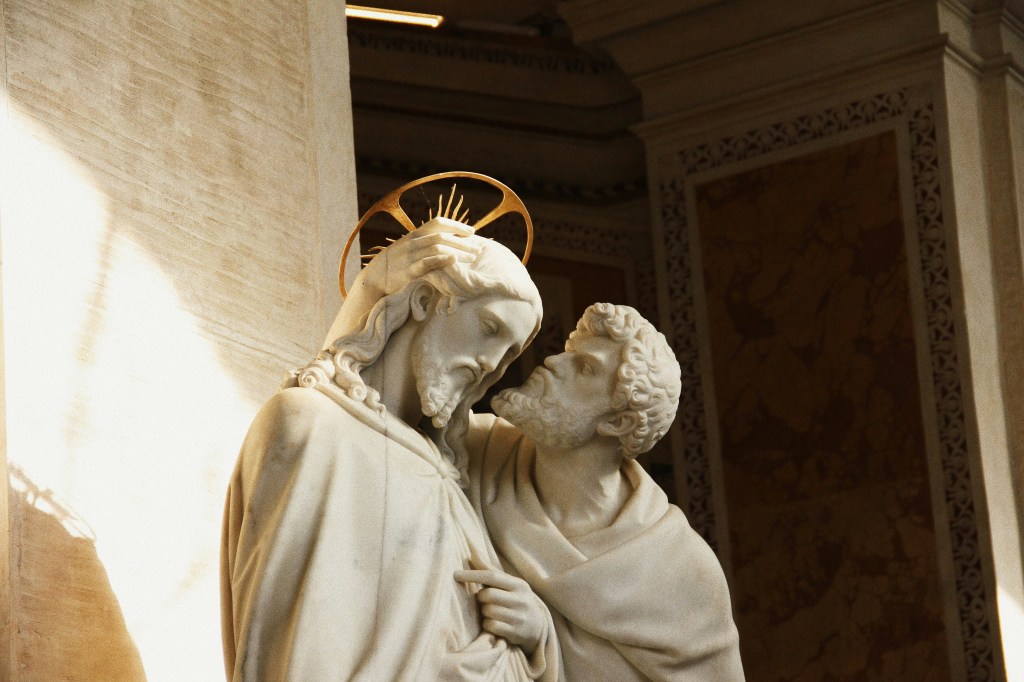
But that doesn’t preach well, nor is it an easy lesson, nor does it give us a model for our own behavior. Maybe it’s not supposed to. Maybe Judas is supposed to force us to look in the mirror, to see the ways in which we too are tragic, and conflicted, and self-preserving, and scared of change. To dismiss Judas as the worst of sinners, to “revile him as a betrayer”, to harbor disdain for him does no justice for Jesus, a victim of state-sanctioned violence. Furthermore, we imperil ourselves when we do not feel Judas’s internal conflict, when we take the gospel writers at their word without considering the forces of power and oppression that were also acting upon Judas that fateful night when he kissed Jesus in the garden. When we ignore the systems that created Judas, opting to supernaturalize his choices, we ignore how the systems that we uphold and participate in now create impossible choices for people. We are less likely to see Judas as human, and anyone else like him as human too.
I once heard that the test of Christianity is not loving Jesus, it is loving Judas. We cannot do that if we continue to vilify him. Poor old Judas. He deserved better than to die of shame and regret. We should all remember that on Good Friday.
One of my big ideas involves a church that has always been run and headed by women. If the women at the empty tomb had been the ones to go into all the world, or if the spreading of the news had been done at their direction, how would the church have evolved differently? If the early followers of Jesus had centered his relationships with women, the poor, the oppressed in their own ministry, how would the church look now? If Christianity had never evolved into a state religion, but had always stayed in the cultural background, what would a church look like in our society?
Amelia stirred the soup pot slowly, watching the liquid bubble. Soon, the family would gather, and she would serve the soup. Adrienne was bringing the bread today, and Erica was bringing the wine. Either Jessica or Amanda was bringing the cake, and whichever one of them was not bringing the cake was bringing the salad. Amelia smiled to herself. Last time the family gathered, there were 40 in the house. It was not the most there had ever been, but it was more that at any point last year. Some of the family had moved, taking other jobs in different cities. Some had stopped coming because the dinners were at the same time as sporting events or school plays. Amelia knew this is how it always was. She did not expect that everyone would come for the meal every week. She had been a Maryam long enough to know that there would always be floating in and out, growing and shrinking. It was never a goal to convince them all to stay. The only goal was to offer them the meal, and the love that came with it.
This is, after all, what Mary had been instructed to do. After her encounter with Christ in the garden, after the men did not believe her story, she knew that it would be her job to carry on the work of Jesus’s life. Mary let the unclean touch her, as Jesus had left the woman who was bleeding touch him. She welcomed the lowest of society, just as Jesus had welcomed the Samaritan woman. She did not refuse a gift, just as Jesus did not refuse the woman who poured out her perfume over his feet. She sat at the feet of her teachers, the older Maryams, to learn, just as Mary had sat at Jesus’s feet to learn.
And she served the soup, every week, just as Martha had prepared her home and a meal for Jesus.
The doorbell rang, and she laid the ladle in the spoon rest, wiping her hands on her apron as he moved through the house, past the folding tables that had been set in the small living room. Soon, they would be packing with people, all gathering to share, eat, learn and grow together. She had set out 10 chairs in the living room, another 20 in the basement, and prepared 6 seats at her table. Anyone else who came tonight could find a spot standing at the kitchen counter, or outside on the deck, as long as the rain held off.
Amelia pulled open the door to reveal Erica, reusable bags in tow. “I brought 10 bottles. I got some non-alcoholic as well,” she said, as she snuck past Amelia into the house. She headed straight for the kitchen, having moved through this routine setup hundreds of times before. Erica’s graying hair was pulled back into a bun today. She was wearing a raincoat and her old sneakers.
Amelia followed her into the kitchen, returning to the huge soup pot on the stove. She turned the heat down on the burner as she regarded Erica. She Amelia tucked a blonde curl that had escaped from her ponytail behind her ear. “I think that will be enough,” she said. “I’m glad you picked up the non-alcoholic too,” she added. “Jim and Valerie will be so appreciative.”
“It’s something we should have been doing this whole time,” Erica said, beginning to unpack the bags and organizing the bottles on the counter. She opened the cabinet above her, and began gathering cups. “I talked to Maryam Bonnie this morning, and she said she had always done that for her family. Of course, her family tends to be a little different than ours.”
It was true. Families attracted different types. That was the point of having so many of them. The family that Amelia, Erica, Jessica, Amanda and Adrienne headed tended to be middle-aged, sometimes a little older, on the wealthier side, busy, with teenagers or college-aged children. Bonnie’s family, which she headed with only one other Maryam, Jenny, attracted people looking to recover from substance abuse. There were thirteen other families in their town—one which tended to have young parents, one with mostly widows, one that served dinner mostly to teenagers. Each one had their own unique flair and flavor. The family atmosphere depended on the Maryams at the head.
Amelia nodded, trying not to feel foolish for not having considered this before. “We’ll make sure we always have it from now on,” she said.
The door opened again, and she heard Amanda yell, “Knock! Knock!” A moment later, Amanda too was in the kitchen. She was carrying a cake pan. “I left the other one in the car. I’ll be right back,” she said, as she deposited it on the counter next to the wine bottles. When she returned, she had Jessica with her. They began to busy themselves arranging the salad bowls, soup bowls, wine cups, forks and spoons. Amelia was pulling the bread plates from the cabinet when the doorbell rang again.
“I hope I’m not too early,” Maggie Clark said. Maggie had been coming for dinner about once a month for five years. She was in her forties, divorced, hoping to remarry. She sometimes brought her son Travis with her. Today, he was also standing on the porch.
Amelia smiled broadly. “No, not too early. We’re just setting everything out. Still waiting for Adrienne to arrive. She’s bringing the bread tonight.”
Maggie followed Amelia to the kitchen, but Travis lingered in the foyer, eyeing the living room and the rows of tables and chairs. “Anything I can help with?” Maggie offered.
“We have it all in order, I think,” Erica answered. Her hair was coming lose from her bun. She took a moment to re-wrap it.
“Okay, I’ll just wait with Travis in the other room,” she said.
“Actually, Maggie, we were hoping to ask you something,” Erica said.
“Oh,” she sounded serious enough to make Maggie pause, and she awkwardly looked at the four Maryams, all who had stilled at Erica’s words. Amelia smiled encouragingly at Maggie, and this seemed to break the tension that had begun to show on her face. “Um, sure. What is it?” she asked.
“We were wondering if you’d ever consider being a Maryam,” Amelia asked, her heart fluttering slightly. Usually they said no on the first ask. But eventually, some of them said yes.
“A…Maryam?” Maggie asked. “Like…like all of you?” She was slightly confused.
“To run a new family, our of your home,” Erica said. “With the help of Amanda.”
Amanda’s sunny smile seemed to melt away the confusion on Maggie’s face. “You think I could?” she asked, smiling herself.
Amelia felt joy bubbling up. “We think you could, Maggie. Would you like to try?”
Maggie was nodding to herself. “Let’s…let’s talk more about it over dinner,” she said.
Amelia and Erica smiled at one another across the kitchen. This is how the family grew. Each new Maryam taking up the mantle of Jesus to serve and welcome in the broken.
Nearly every time I read through the instructions in the Hebrew Bible, I wonder what the text might look like if it was brought forward into the modern world. I don’t think we would be bringing animals and fruits from our fields and gardens. These are not the tokens that we find meaningful now. Below is a reimagining of the offerings from the book of Leviticus. If we followed these instructions, how would it change us and the way we interact with each other?
These are the offerings that you must bring to the altar of the LORD your God, so that you please the LORD your God.
The peace offering is to be brought to the altar when you have offended a neighbor. For an unintended offense, bring a large coffee, hot or iced as your neighbor prefers. You must make any dietary modifications as required or else the peace offering will not be accepted. For an intended offense, you must bring a gift card to your neighbor’s favorite restaurant, in an amount that will cover a meal for them and all their household. Lay the peace offering on the altar of the LORD when you have offended your neighbor. The peace offering must also include a prayer of repentance, whether the offense was intended or unintended, so that you may please the LORD your God.
The gratitude offering is to be brought to the altar when a neighbor has done you a courtesy. The gratitude offering is to be a hand-written letter expressing why your neighbor’s actions had a positive impact on you. Bring the gratitude offering to the altar of the LORD as often as you receive courtesy from your neighbor, so that you may please the LORD your God.
The humility offering is to be brought to the altar when you have lost your temper. If your humility offering is for something small, like a miscommunication or a disagreement about a work project, the offering is to be houseplant that is not easily killed. If the humility offering is made because of a larger blowout, like a fight with a family member on a holiday, the offering is to be a something that can be planted in the yard, like bulbs for the garden, or a fruit tree. Bring the humility offering to the altar of the LORD. The humility offering must also include a prayer of repentance, whether you lost your temper over something small or something large, so that you may please the LORD your God.
The replacement offering is to be brought to the altar when you have accidently lost or destroyed your neighbor’s property. Whatever it was that you lost or destroyed, whether a book, a piece of Tupperware, or an item of clothing, bring an identical item to the altar of the LORD. If you cannot afford to bring a replacement for the item that you lost or destroyed—if for example, the item was something costly like a vehicle, or irreplaceable, like a piece of jewelry from a deceased relative—then the replacement offering is to be a notarized letter stating that you will perform household chores for your neighbor until your labor has paid for the item you lost or destroyed. Your neighbor may not take advantage of you when you are doing this labor and must release you from the labor after the cost of your labor has paid for the cost of the lost or destroyed item. If your neighbor takes advantage of your labor, you are to ask the priest to intervene in the dispute, and the LORD will decide between you and your neighbor.
The empathy offering is to be brought to the altar when you have dismissed your neighbor. Whether this was intended or unintended, the empathy offering must still be brought, so that you may please the LORD. The empathy offering is to be a handmade item that you designed with the dismissed person in mind. It can be anything you feel is fit for your neighbor—a piece of pottery, a drawing, a fibercraft, an original piece of music, a poem or short story. Bring the empathy offering to the altar of the LORD. It must also include a prayer of repentance, whether the dismissal was intended or unintended, so that you may please the LORD your God.
These are the offerings that you must bring to the altar of the LORD your God, so that you please the LORD your God.