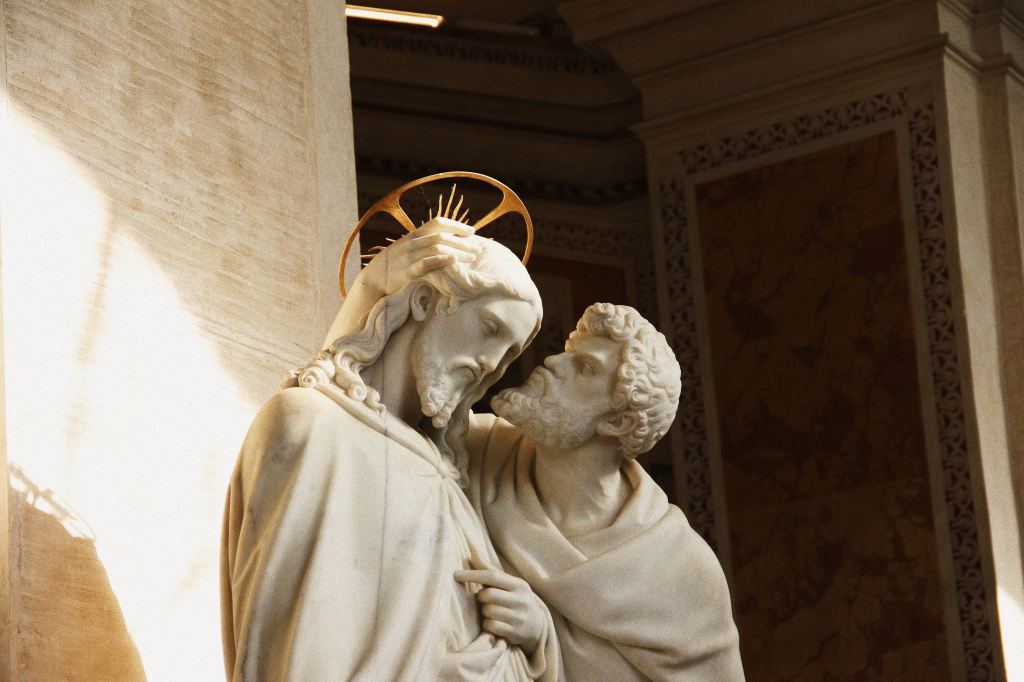
Readers rejoice! You get an extra blog post this week because some things I’ve been thinking about for awhile can no longer be left unsaid.
Last night, I had the great joy of attending a production of Jesus Christ Superstar, a coproduction of Drag Daddy Productions and the Chicken Coop Theatre Company. There were gender swapped roles, sequins, drag queens, fantastic singers and dancers, and many moving moments. All around, an incredible reimagining of a classic show. And it left me wondering a lot about one of the main characters, Judas Iscariot.
If you’ve seen the show, you know that it is very difficult to not feel pity and grief for Judas. But feeling bad for Judas is not often the first response we have to the man who betrayed Jesus of Nazareth. In fact, Christians have for centuries been vilifying and demonizing Judas. Taking the gospel writers at face value, we have assumed that we know his full story: that Satan entered him, that he was tempted by riches, and that he betrayed one of his closest friends.
But when you watch Judas as imagined in Jesus Christ Superstar, we see a completely different story, and as I left the theatre last night, I couldn’t help but feel that we have gotten Judas all wrong. Judas, as portrayed so brilliantly last night by performer Myranda Thomas, is relatable. He is so human, so honest, so heartbroken, so pitiable, so tragic. Today, I keep coming back to the thought that we have done such a disservice to this man.
What if Judas was not possessed by Satan, and tempted by riches? What if instead, Judas was pragmatic and conflicted? What if Judas wanted to believe, but he just couldn’t get there? What if Judas was pulled into a plot by powers he could not fight off alone? What if Judas was pressured into something he did not want to do? What if Judas was trying to save himself? What if Judas was trying to save Jesus from himself? What if Judas just wanted things to go back to the way they were before?
At the risk of spoiling the show, Judas takes his own life because of his deep guilt and pain over what has occurred. When the cast sings “so long Judas. Poor old Judas”, it is a somber, reverent moment that filled my eyes with tears. Poor old Judas indeed. We have made him an enemy, because we do not want to face the things about ourselves that he represents.
Bernard Cornwell, writing from the perspective of his character Uhtred of Bebanburg, a pagan warlord who is living through the Christianization of Britain in the 9th century CE, wrote a line about Judas that has stuck with me since the first moment I read it: “The god had to be nailed to a cross if he was to become their savior, and then the Christians blame the man who made that death possible. I thought they should worship him as a saint, but instead they revile him as a betrayer.” To Uhtred, this seems like a contradiction, and honestly, the more I think about it, I’m on Uhtred’s side.
But that doesn’t preach well, nor is it an easy lesson, nor does it give us a model for our own behavior. Maybe it’s not supposed to. Maybe Judas is supposed to force us to look in the mirror, to see the ways in which we too are tragic, and conflicted, and self-preserving, and scared of change. To dismiss Judas as the worst of sinners, to “revile him as a betrayer”, to harbor disdain for him does no justice for Jesus, a victim of state-sanctioned violence. Furthermore, we imperil ourselves when we do not feel Judas’s internal conflict, when we take the gospel writers at their word without considering the forces of power and oppression that were also acting upon Judas that fateful night when he kissed Jesus in the garden. When we ignore the systems that created Judas, opting to supernaturalize his choices, we ignore how the systems that we uphold and participate in now create impossible choices for people. We are less likely to see Judas as human, and anyone else like him as human too.
I once heard that the test of Christianity is not loving Jesus, it is loving Judas. We cannot do that if we continue to vilify him. Poor old Judas. He deserved better than to die of shame and regret. We should all remember that on Good Friday.
One of my big ideas involves a church that has always been run and headed by women. If the women at the empty tomb had been the ones to go into all the world, or if the spreading of the news had been done at their direction, how would the church have evolved differently? If the early followers of Jesus had centered his relationships with women, the poor, the oppressed in their own ministry, how would the church look now? If Christianity had never evolved into a state religion, but had always stayed in the cultural background, what would a church look like in our society?
Amelia stirred the soup pot slowly, watching the liquid bubble. Soon, the family would gather, and she would serve the soup. Adrienne was bringing the bread today, and Erica was bringing the wine. Either Jessica or Amanda was bringing the cake, and whichever one of them was not bringing the cake was bringing the salad. Amelia smiled to herself. Last time the family gathered, there were 40 in the house. It was not the most there had ever been, but it was more that at any point last year. Some of the family had moved, taking other jobs in different cities. Some had stopped coming because the dinners were at the same time as sporting events or school plays. Amelia knew this is how it always was. She did not expect that everyone would come for the meal every week. She had been a Maryam long enough to know that there would always be floating in and out, growing and shrinking. It was never a goal to convince them all to stay. The only goal was to offer them the meal, and the love that came with it.
This is, after all, what Mary had been instructed to do. After her encounter with Christ in the garden, after the men did not believe her story, she knew that it would be her job to carry on the work of Jesus’s life. Mary let the unclean touch her, as Jesus had left the woman who was bleeding touch him. She welcomed the lowest of society, just as Jesus had welcomed the Samaritan woman. She did not refuse a gift, just as Jesus did not refuse the woman who poured out her perfume over his feet. She sat at the feet of her teachers, the older Maryams, to learn, just as Mary had sat at Jesus’s feet to learn.
And she served the soup, every week, just as Martha had prepared her home and a meal for Jesus.
The doorbell rang, and she laid the ladle in the spoon rest, wiping her hands on her apron as he moved through the house, past the folding tables that had been set in the small living room. Soon, they would be packing with people, all gathering to share, eat, learn and grow together. She had set out 10 chairs in the living room, another 20 in the basement, and prepared 6 seats at her table. Anyone else who came tonight could find a spot standing at the kitchen counter, or outside on the deck, as long as the rain held off.
Amelia pulled open the door to reveal Erica, reusable bags in tow. “I brought 10 bottles. I got some non-alcoholic as well,” she said, as she snuck past Amelia into the house. She headed straight for the kitchen, having moved through this routine setup hundreds of times before. Erica’s graying hair was pulled back into a bun today. She was wearing a raincoat and her old sneakers.
Amelia followed her into the kitchen, returning to the huge soup pot on the stove. She turned the heat down on the burner as she regarded Erica. She Amelia tucked a blonde curl that had escaped from her ponytail behind her ear. “I think that will be enough,” she said. “I’m glad you picked up the non-alcoholic too,” she added. “Jim and Valerie will be so appreciative.”
“It’s something we should have been doing this whole time,” Erica said, beginning to unpack the bags and organizing the bottles on the counter. She opened the cabinet above her, and began gathering cups. “I talked to Maryam Bonnie this morning, and she said she had always done that for her family. Of course, her family tends to be a little different than ours.”
It was true. Families attracted different types. That was the point of having so many of them. The family that Amelia, Erica, Jessica, Amanda and Adrienne headed tended to be middle-aged, sometimes a little older, on the wealthier side, busy, with teenagers or college-aged children. Bonnie’s family, which she headed with only one other Maryam, Jenny, attracted people looking to recover from substance abuse. There were thirteen other families in their town—one which tended to have young parents, one with mostly widows, one that served dinner mostly to teenagers. Each one had their own unique flair and flavor. The family atmosphere depended on the Maryams at the head.
Amelia nodded, trying not to feel foolish for not having considered this before. “We’ll make sure we always have it from now on,” she said.
The door opened again, and she heard Amanda yell, “Knock! Knock!” A moment later, Amanda too was in the kitchen. She was carrying a cake pan. “I left the other one in the car. I’ll be right back,” she said, as she deposited it on the counter next to the wine bottles. When she returned, she had Jessica with her. They began to busy themselves arranging the salad bowls, soup bowls, wine cups, forks and spoons. Amelia was pulling the bread plates from the cabinet when the doorbell rang again.
“I hope I’m not too early,” Maggie Clark said. Maggie had been coming for dinner about once a month for five years. She was in her forties, divorced, hoping to remarry. She sometimes brought her son Travis with her. Today, he was also standing on the porch.
Amelia smiled broadly. “No, not too early. We’re just setting everything out. Still waiting for Adrienne to arrive. She’s bringing the bread tonight.”
Maggie followed Amelia to the kitchen, but Travis lingered in the foyer, eyeing the living room and the rows of tables and chairs. “Anything I can help with?” Maggie offered.
“We have it all in order, I think,” Erica answered. Her hair was coming lose from her bun. She took a moment to re-wrap it.
“Okay, I’ll just wait with Travis in the other room,” she said.
“Actually, Maggie, we were hoping to ask you something,” Erica said.
“Oh,” she sounded serious enough to make Maggie pause, and she awkwardly looked at the four Maryams, all who had stilled at Erica’s words. Amelia smiled encouragingly at Maggie, and this seemed to break the tension that had begun to show on her face. “Um, sure. What is it?” she asked.
“We were wondering if you’d ever consider being a Maryam,” Amelia asked, her heart fluttering slightly. Usually they said no on the first ask. But eventually, some of them said yes.
“A…Maryam?” Maggie asked. “Like…like all of you?” She was slightly confused.
“To run a new family, our of your home,” Erica said. “With the help of Amanda.”
Amanda’s sunny smile seemed to melt away the confusion on Maggie’s face. “You think I could?” she asked, smiling herself.
Amelia felt joy bubbling up. “We think you could, Maggie. Would you like to try?”
Maggie was nodding to herself. “Let’s…let’s talk more about it over dinner,” she said.
Amelia and Erica smiled at one another across the kitchen. This is how the family grew. Each new Maryam taking up the mantle of Jesus to serve and welcome in the broken.
Nearly every time I read through the instructions in the Hebrew Bible, I wonder what the text might look like if it was brought forward into the modern world. I don’t think we would be bringing animals and fruits from our fields and gardens. These are not the tokens that we find meaningful now. Below is a reimagining of the offerings from the book of Leviticus. If we followed these instructions, how would it change us and the way we interact with each other?
These are the offerings that you must bring to the altar of the LORD your God, so that you please the LORD your God.
The peace offering is to be brought to the altar when you have offended a neighbor. For an unintended offense, bring a large coffee, hot or iced as your neighbor prefers. You must make any dietary modifications as required or else the peace offering will not be accepted. For an intended offense, you must bring a gift card to your neighbor’s favorite restaurant, in an amount that will cover a meal for them and all their household. Lay the peace offering on the altar of the LORD when you have offended your neighbor. The peace offering must also include a prayer of repentance, whether the offense was intended or unintended, so that you may please the LORD your God.
The gratitude offering is to be brought to the altar when a neighbor has done you a courtesy. The gratitude offering is to be a hand-written letter expressing why your neighbor’s actions had a positive impact on you. Bring the gratitude offering to the altar of the LORD as often as you receive courtesy from your neighbor, so that you may please the LORD your God.
The humility offering is to be brought to the altar when you have lost your temper. If your humility offering is for something small, like a miscommunication or a disagreement about a work project, the offering is to be houseplant that is not easily killed. If the humility offering is made because of a larger blowout, like a fight with a family member on a holiday, the offering is to be a something that can be planted in the yard, like bulbs for the garden, or a fruit tree. Bring the humility offering to the altar of the LORD. The humility offering must also include a prayer of repentance, whether you lost your temper over something small or something large, so that you may please the LORD your God.
The replacement offering is to be brought to the altar when you have accidently lost or destroyed your neighbor’s property. Whatever it was that you lost or destroyed, whether a book, a piece of Tupperware, or an item of clothing, bring an identical item to the altar of the LORD. If you cannot afford to bring a replacement for the item that you lost or destroyed—if for example, the item was something costly like a vehicle, or irreplaceable, like a piece of jewelry from a deceased relative—then the replacement offering is to be a notarized letter stating that you will perform household chores for your neighbor until your labor has paid for the item you lost or destroyed. Your neighbor may not take advantage of you when you are doing this labor and must release you from the labor after the cost of your labor has paid for the cost of the lost or destroyed item. If your neighbor takes advantage of your labor, you are to ask the priest to intervene in the dispute, and the LORD will decide between you and your neighbor.
The empathy offering is to be brought to the altar when you have dismissed your neighbor. Whether this was intended or unintended, the empathy offering must still be brought, so that you may please the LORD. The empathy offering is to be a handmade item that you designed with the dismissed person in mind. It can be anything you feel is fit for your neighbor—a piece of pottery, a drawing, a fibercraft, an original piece of music, a poem or short story. Bring the empathy offering to the altar of the LORD. It must also include a prayer of repentance, whether the dismissal was intended or unintended, so that you may please the LORD your God.
These are the offerings that you must bring to the altar of the LORD your God, so that you please the LORD your God.
There was a hum in the air around me. The expansive room was filled with other people, but I barely noticed them. I was centered on the statue in front of me. It had been placed behind a wall of glass to protect it, to separate it from the people who came to view it. It didn’t seem separated from me though, as I stood alone, wondering. The perfectly placed lighting highlighted all of Mary’s features so I could see her serene expression. For a moment, everything around me faded—the noise, the other visitors to the basilica, the tour guides giving lectures around me. For one holy moment, Mary and I were the only people in the room.
My eyes trailed over the body of the crucified Jesus laid across her lap. I felt particularly drawn to the way his hand dangled lifeless towards the earth, and the way the hand of his mother cradled him around his ribs. Michelangelo did not give him any wounds on his hands or feet, or in his side, but he didn’t need to. The agony of the crucifixion was carved into the way his body draped over Mary’s. I could almost imagine the strength of her legs, how the muscles in her arms must have strained under his weight. My eyes went back to her face, her perfectly serene face. This was not the face of a mother who had lost her son. There was a transcendent expression there, as if she had prepared herself for this. As if she always knew holding her son in this way is something she would one day do.
My ears tuned in to one of the tour groups in the basilica. The group was just a few feet ahead of me, and I could hear their guide clearly. She was explaining the debate about Mary’s youth. Why, she asked, did Michelangelo choose to make Mary so young when he carved his famous Pieta? She would have been in her forties when Jesus was killed, but Michelangelo’s Mary appears to be a young woman. The guide offered several explanations before sharing what she named to be her favorite. “This is not Mary holding the crucified Christ,” she said. “This is a statue of Mary holding the infant Jesus, imagining what her son would do for her.”
I looked at Mary’s face again, tears stinging my eyes, as I contemplated the price she paid.
I don’t claim to know how salvation actually works. I’m still unclear why Jesus died, and how his death is redemptive. I admittedly don’t like to think about his death at all, because uncertainty swirls around it when I do. The nagging questions—why?—never seem to fall away from me. Doubt is always mingling inside me, running right alongside faith. But that day, I didn’t feel any doubt. God was with me in the basilica as I contemplated his death, and I felt certain he would stay with me wherever else I went.
It was a formative spiritual experience. I can’t think of many other times in my life when I have felt as close to God as I felt that April afternoon in 2004. There are a handful of other experiences that moved me to tears or lifted the veil, but viewing the Pieta was wholly unlike them. I had traveled thousands of miles, with other teenagers whom I barely knew, to a city where I didn’t speak the language. I was truly a stranger, and yet, God transcended the borders and the barriers. God found me, exactly where I was, and it felt like God had led me there to hear the words of that tour guide as I cried over a beautiful piece of sculpture.
Even now when I think about Mary, no matter the context, my mind goes back to the face of Michelangelo’s Mary. Her absolutely pristine face, her painless expression, as if she truly believed her son was the savior of the world. As if she had prepared all her life to accept what God had planned for him. As if she was ready for it. As if she welcomed it.
Could I ever, if only for a moment, be like Mary? Just once? Please, God. Help me believe.
It’s a prayer. It’s a lament. It’s the angry words I have as I shake my fist. It’s yelling into the wind. It’s my insecurities laid bare. It’s me allowing myself to feel like I’m not enough as I am. That my faith isn’t good enough. That my faith isn’t strong because I still have doubts. That maybe next time, God won’t meet me where I am. Faith does not come easily for me, and it never has. But there has also never been a convincing reason for me to turn away from faith completely, because every time I’ve been right on the edge of unbelief, God meets me there. God will always meet me; that is my one certainty.
Yet, Mary didn’t have an easy road either. Michelangelo’s Mary, if she is holding her infant son and imaging his sacrifice, is Mary postpartum, when the hope and joy of the baby has already been realized. There was a long and difficult road she walked before she beheld him, before she wrapped him in her arms and cradled him against her chest. Before the miracle that we now call Christmas, she spent months carrying him—months that I imagine were full of wonder, but just as easily could have been filled with doubt. When she visited her cousin Elizabeth, was she hiding? When Joseph planned to divorce her, did she know? When she was laboring, did she cry out to God to end the pain?
I’ve had the honor of assisting women in birth when I work as a doula. No matter where or how a baby is born, there is always a moment when the mother says, “I can’t do this.” She is always wrong, but I would never say that to her. Instead, I gently remind her that she has all the power she needs inside of her already. I remind her that she can. I tell her that I’m watching her do it. I tell her that she must surrender to what is happening. “Don’t fight with the pain,” I say. “Let it carry you.”
There is another Mary is often imagine, especially at Christmas, and she is not serene or accepting. When I think of Mary and the infant Jesus, I can’t help but think of how Jesus was born. I’ve watched enough women give birth to know that it’s the hardest physical work that many of them will ever experience. I imagine Mary, told that she must sleep where the animals sleep, laboring among them. This Mary cries out in desperation. She doubts her strength. She ignores the world around her to survive the agony she’s experiencing. I wonder if Joseph went to find other women to attend her. I wonder if she had anyone to remind her of her strength as she squatted, dripping with sweat, shaking and puking from the pain, to push her son into the world. Did they wipe her brow? Did they give her a sip of water? Did they let her clutch their arms until her knuckles were white?
I think about afterwards, when the shepherds came to see the baby. Was she trying to nurse him? Was he crying from hunger and frustration? Had she already delivered the afterbirth? Was she still bleeding? Was she longing for sleep? Did she lose the color in her lips when they tried to move her about too soon? Was she aching from a tear? She wouldn’t have had ice packs, or witch hazel pads, a peri-bottle, or a sitz bath, so what did they give her for the pain?
I know this Mary, because she is me. The Mary who does the messy—and gross—work of birthing the Christ child is the Mary I can easily identify with. She must labor to bring about hope. She must work, harder than she has ever worked, to bring joy. She doesn’t trust herself; she doubts the power she has been given. She focuses on the agony of the moment to keep it from overpowering her. She cries out “how much longer?” She screams, “I can’t do this.”
The desperate Mary in labor does not know the joy of the serene Mary holding the baby, just as Mary holding the baby forgets the nerve-shattering experience that allowed her to hold him. Yet she is the same woman. The truth is both images are true, held in tension with one another. I’m sure Mary doubted at times, just as I’m sure she believed. If the mother of God had doubts, then surely, I can as well.
I started a master’s program this week. I am studying religion with an emphasis in Biblical studies at Louisville Presbyterian Theological Seminary. This is something I have wanted to pursue for about 14 years, but never had the courage to apply, until this past spring. There is something transformative that happens to you when you surround yourself with people who really believe in the value that you bring. I’m thankful for the friends who encouraged me explicitly and implicitly to pursue this. Below is one of the essays I wrote as part of my application.
When I think about who God is, there is ultimately one word that comes to mind: love. Love, and God, manifests in many forms, but each way can be stripped back to this basic idea.
God loves people. From the very beginnings of the story of our faith, we see God loving and caring for people. Genesis tells us that God did not want Adam to be alone, and so God created Eve. When God calls Abram out of Ur to go to a new land, God does not put conditions on the promises, saying “I’ll give you this land if…” God hears Hagar crying out in despair and meets her in her pain. God rescues the Israelites from slavery and protects them on their journey through the wilderness. God continually forgives when the Israelites repent of their idolatry. God even entered the human story as a human, to walk beside us and show us—personally—the ways of righteousness.
Jesus shows us great love in the way he welcomed and cared for the afflicted, the oppressed, those who were ridiculed or dismissed by society, and those who were seen as outside of the Jewish society. When Jesus talks of his father in heaven, we see the picture of a just God, one who loves and accepts, who calls for humility and offers grace. Jesus loved his friends, surely, but also his enemies, healing the ear of one of the soldiers sent to arrest him, and praying for the crowd as he was dying.
God loves the earth. Scripture tells us that what God created was good. It reminds us that God cares for the sparrows just as he does for us. It teaches us the earth will praise God—yes, even the rocks will cry out—and that the trees of the field with clap their hands in joy. God cared for the animals that the Israelites used as sacrifices, by commanding merciful treatment of them through Levitical law. God created a richly beauteous world that is full of wonder. The very complexity of interconnectedness of the natural world signals to me that God loves the earth enough to spend the care it takes to put such a complex system into motion.
When I think about the ways in which God loves, I also feel the amazing power God has to transform. God is always transforming me—sometimes through pruning, and sometimes through letting me grow. Just as a gardener will dead head the rose bushes, so the flowers will keep growing, so God clips away all the unhealthy parts of me. God is a caretaker, and caretaking is at its very heart, a kind of love. It is the kind of love that wants to see a flourishing, but it is also a sacrificial kind of love. As the caretaker of my garden, I want to see my plants thrive. I take time to make sure that happens, watering them, pruning them, giving them extra fertilizer when they need it, pulling out the weeds that could choke them out. In the same way, as a caretake for my children, I put in the effort it takes to have them grow into responsible, kind, loving and self-aware adults. This takes time, patience, effort—sometimes it even takes tears. This is how I imagine God, constantly working on me, constantly beside me, guiding me, leading me, teaching me.
Jesus’s parables are full of the imagery of the garden and the farm. There are cultural reasons why he would have chosen these metaphors, but I think the genius of Jesus’ teachings is that they transcend their own time period, calling us to think about one of our most basic needs. Humans will always have a need to grow food, whether we do it industrially or individually. Jesus used imagery of the earth and how to care for it in his teachings on how God cares for us, and to show us how to live life to the fullest. This underscores the importance of God’s love for the earth at the same time it shows us God’s love for people. Pastoralists and practitioners of early agriculture would have known that to care for the farm or the garden was critical to survival. Jesus using this imagery shows how critical God’s love and care is for our own spiritual health and survival. Without it, we would surely wither, just as the vine does without proper care.
Finally, God loves me. Yes, even me. Though I might not feel like it at all times, God continually loves me. God loves me enough to open doors for me. God loves me enough to push to me to grow. God loves me enough to send me comfort when I am hurting. God loves me enough to give me opportunities to flourish and to use the gifts I have been given. God loves me enough to reveal Godself to me continuously, through my mentorships and friendships. God has loved me when I am at my worst, and God has loved me when I am at my best, and I know God will always do this. God is, ultimately, the best gardener and caretaker I know.