
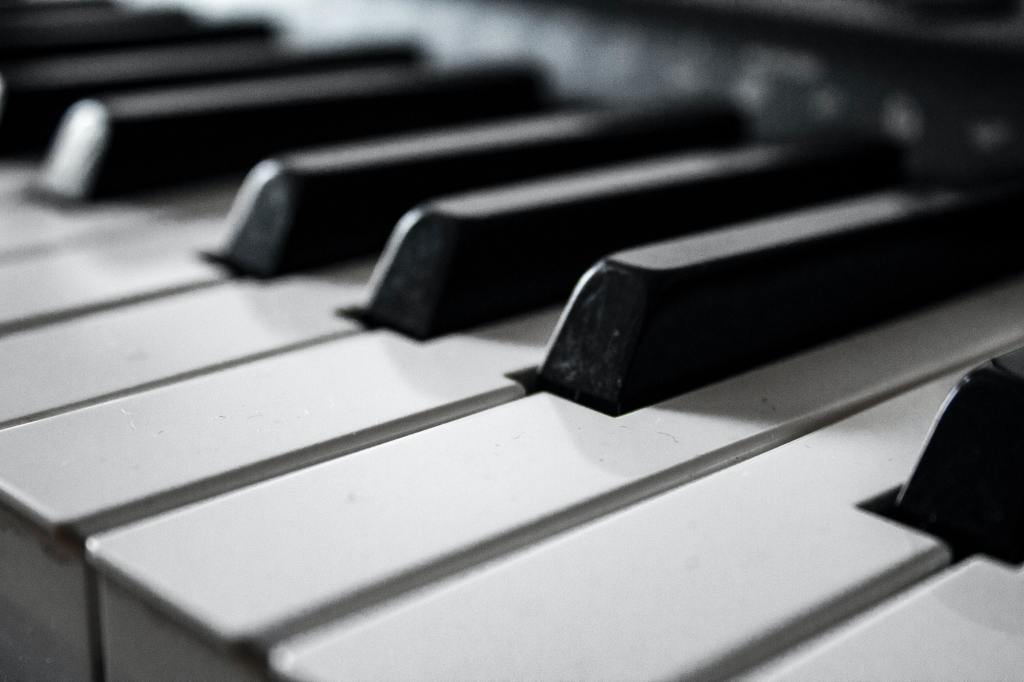
The house was hot, the air stifling and smokey from the candles that burned in every room. A draft blew up from under the door to the bathroom across the hall. He’d left the window open. He sat silently at the piano, feet bare, wearing only his underwear, smoking a cigarette. He waited for the clock to strike. He sat here every night waiting for the clock to strike. And as soon as the chimes rang, he played. He would play until the sun peered into his window the next morning.
It hadn’t always been like this. There were times he was sure that he had been normal—not nocturnal—and lived a normal life, but there had been an accident, and now, this was his life. Sitting up all night, every night, playing piano without pause. In fact, he vaguely remembered a time when he didn’t want to play piano at all, when his mother forced him to sit and practice until his back hurt from keeping proper posture. There had been days like that, but he wasn’t sure if they had been real, or if he had only imagined them, scenes taken from his nightmares.
He tapped his cigarette ashes off into the little glass tray sitting on the table beside him. He looked at the clock. In a few minutes, it would be time. The heat from the fires burning around his small apartment had made him unbelievably sweaty, but he wouldn’t unlight the candles until he went to sleep. He would not go to sleep until he saw the sun. The sun would not come until he had played the piano all night. He could not play until the clock chimed.
Popping his toes, he stretched. There was a dull pounding in his brain. It came to him every night just as the clock was about to chime. The clock would strike, he would go into a trance and pay the notes that were ingrained into him. All the old masters, like Beethoven and Mozart and the new writers like Gethben and Sultchuz, even musical pieces he has composed himself, would flow out of him, playing on the keys, lulling the neighbors into dreams. When he played, he was free from the life here in the city. He was unchained by his urban habitation. He wandered through ancient forests and over seas, under mountains beneath a blanket of bright stars.
It was almost time. He put out his cigarette and prepared to play as he watched the clock’s hands come ever, ever closer to 9. He felt his hands begin to sweat as he rested his fingers on the ivory keys. Pianos keys were rarely made from ivory anymore. Actually, no pianos keys were made from real ivory. The elephant had died out long before he was born and the only ivory available now was produced in a lab. It was expensive, and companies that produced pianos—which, in fact, was only one company—used pristine, clinically white plastic instead. But he had received this piano from his great grandmother, who had died shortly after the turn of the century. It was old, older than his great-grandmother. After the accident, he had become obsessed with restoring it to its proper glory. He was proud to know that his piano’s keys were real ivory, from a long dead elephant that he had never seen.
The clock struck suddenly. As it chimed, he banged on the keys, then lightly played a much softer melody, and then a sad song, and then a ballad of spring. He felt the pounding in his head rest as he tinkered away at the piano.
The neighbors in their beds heard not a note at all, and those who were up late for a snack listened to the music respectfully. They had become accustomed to his nighttime playing, and frankly, it no longer bothered most of them. They all knew what had happened to poor Edward years ago when the waters had risen and the beach had been swallowed. He hadn’t been right since it happened. So, they let him sit in solitude and play his great-grandmother’s piano, with all the candles turned on in the middle of the night. As long as Edward didn’t knock over those candles and set the whole complex on fire, no one cared to bother him about his nocturnal preoccupation. After all, what would you expect from a man named after his mother’s mother’s great grandfather’s great uncle? With a name like Edward, who would be a normal human being?
Of course, before the war everyone had been named strange old names like Edward. The mayor’s name had been Bill, the pastor had been called Peter, the midwife’s name was Ruth. Edward’s neighbors had all had names like Susan and Lucy and Edmond. Edward’s wife has been named Irene. But no one would remember this once they were gone. There were no records of the names peoples had been called before the war. In fact, there was no record of the war. The war was only remembered by Edward, who now lived alone because of the accident.
It had been a freak accident, indeed. Edward often thought of it when he was alone, all the candles burning as he played his piano. When he played, and it was dark, and the world was asleep, there was nothing else to think of, since the accident was the reason he played. Before that day, his great-grandmother’s piano had sat untouched in the living room, covered in a thin layer of dust. He glanced at it once in a while, but never did he sit down at the bench and play the way he played now. If his mother could only see him! How proud she would be with his devotion. But his mother had passed during the war, before the accident. Her name had been Maria. Who knows what name the monsters would have given her, had she not died during their exterminations. Edward had known another Maria as well. She lived units over in his complex, but her name was now Gerara. In the monsters’ language it was a praise of beauty. But it was in no way as beautiful a name as Maria.
Edward remembered his mother, her gentle touch, her soft voice, her curling dark hair. Her face was always lean, her lips always pouty, and her eyes always thoughtful. During the war, they were seldom dry. She had cried nearly every night over the death of Edward’s father. Although he had perished years and years before in a country called Afghanistan, the war with the monsters reminded her of the war with the Afghans. As far as he knew, that country—as well as his own, the United States of America—had been broken apart and redivided into sections by the monsters.
He rarely thought of the monsters. There was no point. They had come, they had conquered the world through mass extermination, and now they ruled from their centralized brain located deep underground, where it was warm. The monsters thought the surface was unbearably cold. No human could go down into the earth, towards the core, where their city grew, for the heat would have burned them to ash. Despite their separation, the monsters still held humans in their grasp. For the most part, they looked after their well-being and he was not oppressed, so why would he complain?
In fact, it was the monsters who had led him to be what he was now. The monsters had made him into the drone that sat and played the piano every night until the sun rose over the horizon. Edward secretly admired the monsters, although he never had the courage to admit it aloud. Edward was the product of their experiments, a being that had been reformed into a worker for the good of the monsters. The music he played soothed their thoughts and worries. The notes vibrated down into the hive where they lived, while they relaxed after a long day of building. What they were building, no one ever knew, and where they were getting the supplies, no one dared to guess—thieving them from the humans was probably the answer. They could be heard in the daytime clanking and cracking and rumbling in the deep. When the night fell, they became strangely quiet as they became drunk from the music Edward played on his piano miles and miles above their heads.
Sweat dripped from his brow and he paused momentarily to wipe it away. The sky was progressively becoming lighter, a soft gray of morning that had come to mean it was time to rest. Slowly, he finished his musical selection and rose from the bench. He was drenched with sweat, tired with aches in his hands and legs. The fatigue penetrated to his bones. Around his apartment he went, blowing out the candles he had lit to set him in the right mood. He wiped his face with the towel hanging on the doorknob of his bedroom, pushed open the door and collapsed onto the bed, soft and wonderful under his body. Sleep came, uninterrupted by dreams.
 The Quick and the Dead