
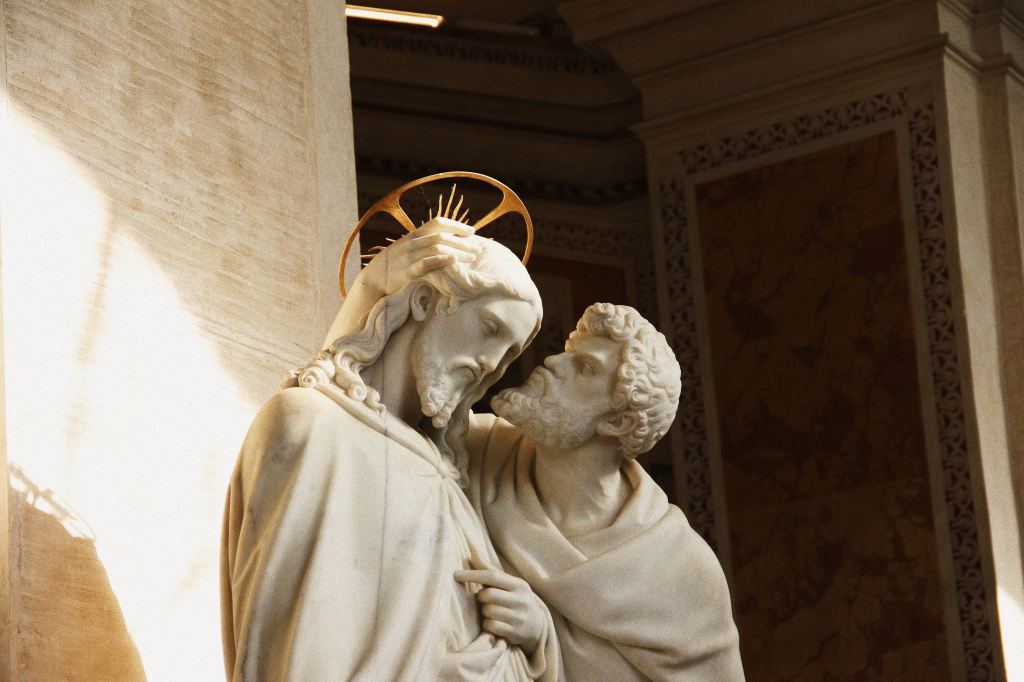
This post was originally published on August 12th, 2023. I often think of Judas on Good Friday, since he is a key figure in the Passion narrative. And really, without a betrayal, would the story of Jesus’ arrest and execution be as painful? Betrayal is one of the worst kinds of interpersonal wrongs; it is a unique kind of pain that damages us forever. I have found that betrayal is one of the hardest hurts to heal. Perhaps that is why I think of Judas and Jesus on Good Friday, and the absolute tragedy of how their relationship went awry.
Readers rejoice! You get an extra blog post this week because some things I’ve been thinking about for awhile can no longer be left unsaid.
Last night, I had the great joy of attending a production of Jesus Christ Superstar, a coproduction of Drag Daddy Productions and the Chicken Coop Theatre Company. There were gender swapped roles, sequins, drag queens, fantastic singers and dancers, and many moving moments. All around, an incredible reimagining of a classic show. And it left me wondering a lot about one of the main characters, Judas Iscariot.
If you’ve seen the show, you know that it is very difficult to not feel pity and grief for Judas. But feeling bad for Judas is not often the first response we have to the man who betrayed Jesus of Nazareth. In fact, Christians have for centuries been vilifying and demonizing Judas. Taking the gospel writers at face value, we have assumed that we know his full story: that Satan entered him, that he was tempted by riches, and that he betrayed one of his closest friends.
But when you watch Judas as imagined in Jesus Christ Superstar, we see a completely different story, and as I left the theatre last night, I couldn’t help but feel that we have gotten Judas all wrong. Judas, as portrayed so brilliantly last night by performer Myranda Thomas, is relatable. He is so human, so honest, so heartbroken, so pitiable, so tragic. Today, I keep coming back to the thought that we have done such a disservice to this man.
What if Judas was not possessed by Satan, and tempted by riches? What if instead, Judas was pragmatic and conflicted? What if Judas wanted to believe, but he just couldn’t get there? What if Judas was pulled into a plot by powers he could not fight off alone? What if Judas was pressured into something he did not want to do? What if Judas was trying to save himself? What if Judas was trying to save Jesus from himself? What if Judas just wanted things to go back to the way they were before?
At the risk of spoiling the show, Judas takes his own life because of his deep guilt and pain over what has occurred. When the cast sings “so long Judas. Poor old Judas”, it is a somber, reverent moment that filled my eyes with tears. Poor old Judas indeed. We have made him an enemy, because we do not want to face the things about ourselves that he represents.
Bernard Cornwell, writing from the perspective of his character Uhtred of Bebanburg, a pagan warlord who is living through the Christianization of Britain in the 9th century CE, wrote a line about Judas that has stuck with me since the first moment I read it: “The god had to be nailed to a cross if he was to become their savior, and then the Christians blame the man who made that death possible. I thought they should worship him as a saint, but instead they revile him as a betrayer.” To Uhtred, this seems like a contradiction, and honestly, the more I think about it, I’m on Uhtred’s side.
But that doesn’t preach well, nor is it an easy lesson, nor does it give us a model for our own behavior. Maybe it’s not supposed to. Maybe Judas is supposed to force us to look in the mirror, to see the ways in which we too are tragic, and conflicted, and self-preserving, and scared of change. To dismiss Judas as the worst of sinners, to “revile him as a betrayer”, to harbor disdain for him does no justice for Jesus, a victim of state-sanctioned violence. Furthermore, we imperil ourselves when we do not feel Judas’s internal conflict, when we take the gospel writers at their word without considering the forces of power and oppression that were also acting upon Judas that fateful night when he kissed Jesus in the garden. When we ignore the systems that created Judas, opting to supernaturalize his choices, we ignore how the systems that we uphold and participate in now create impossible choices for people. We are less likely to see Judas as human, and anyone else like him as human too.
I once heard that the test of Christianity is not loving Jesus, it is loving Judas. We cannot do that if we continue to vilify him. Poor old Judas. He deserved better than to die of shame and regret. We should all remember that on Good Friday.
 The Quick and the Dead