I lived with Osburga until the season started to turn, and the cold set in, the mornings frosty and the evenings holding a chill that crept into my bones. I had seen my father once, his eyes understanding, even if he was sad. He knew he couldn’t protect me. Only another woman like me had a chance of doing that.
Osburga didn’t teach me anything about the sight. We gathered herbs, and dug roots and chopped ingredients for soups and potions, and sometimes a man would show up and she would send me out of the cottage for a few hours. She slept soundly at night, thought I would wake at the faintest scratch in the forest. She said I would get used to it. As the autumn stretched on, I wondered if she was right about that like she was right about nearly everything else.
“You’re too careful,” she said one wintery morning, when not even the fire could warm me. She was sipping mead from her mug, and gnawing a hunk of bread, wrapped in a huge blanket as she sat at the table. I was crouched near the hearth, warming my hands, watching the flames, listening to the fire crackle. It reminded me of the snap of the horse’s leg.
“Don’t want to get burned,” I said over my shoulder.
“I wasn’t talking about the fire,” Osburga said.
I had known that, but I was afraid of her pushing me. This was not the first time that she had commented on my timidity. “How do I conquer the fear?” I asked, wanting more. The taste of something greater was within reach, but I couldn’t quite open myself to it. It had killed my gran, and driven my mother away. Why did I want it?
“You don’t conquer the fear, little witch,” she said. The term was endearing now, after months of it rolling off her tongue. “You accept the fear, and go forth in spite of it.”
“Accept the fear,” I echoed. My hands and face were finally warm. I stood and turned by backside to the hearth. I met her gaze as I tugged my shawl tighter around me. Osburga sipped from her mug without taking her eyes from me. I felt my throat tighten, and my mouth go nearly dry as I thought about all that I had seen of my mother’s journey from home. I had learned how to see her, to follow her path from our village to the forest, and from the forest to the open wild lands, and to a churchyard where she had met a nun, and then into a nunnery. The sight had taken me with her across these years. I could see where she had been, but I still did not know where she was.
“Perhaps she is still in the convent,” I said. Osburga and I had talked about this often. She knew that it was the last thing I could see about my mother. She went with the sister into the convent. She did not wear a habit when she went to prayer. That was all that I knew. “Maybe that’s why I can’t see her. I can’t see things that are, only things that were.”
Osburga was still studying me. She took another sip from her mug. The fire was roasting my rear, so I took a step towards her. She put the mug down on the table, and took a bite of the bread in her other hand. Saying nothing as I reasoned out a problem was Osburga’s preferred method of instruction. She said nothing, so I knew I had gotten it wrong.
“Accept the fear, ” I said again. Osburga continued chewing slowly. I sighed and crossed the room to the table, sitting opposite her. She tore off a hunk of the bread and passed it to me. I bit into it and methodically chewed along with her.
“Did you know that King Eadwig is ill?” she asked me.
A test. Osburga could see what was as easily as she could see what had been. She wanted me to accept the fear to see for myself.
A shiver ran over me, one that wasn’t related to the chill in the house. It was the kind of chill that accompanied a fever. Fear shook me. A fever could kill. I swallowed the lump in my throat, waiting for what the sight would show me. I closed by eyes, slowed my breathing, and felt the fear in my belly like a stone. I focused on it, drifting down to meet it. I opened to it, and then suddenly, I saw him. King Eadwig was burning with fever, in a grand bed, nearly out of his mind with pain. There were men standing around the bed, observing, powerless to do anything for him but offer beer and wine. He was sweating, and his skin was pale, like death had already touched him. I pressed a hand to my face, feeling the fever in my own cheek.
“He’s dying,” I croaked, my throat tight with fear. It was not to be spoken. The King was anointed by God. To speak of his death was to speak a curse.
I opened my eyes, peeling myself away from the vision that the sight had given me. Osburga was smiling at me. “Do you think they will accuse a woman of bewitching him?” she asked.
I knew nothing about King Eadwig, except that Cynewulf was his ealdorman, and that Cynewulf had ruined my mother’s life. “If there is a woman near enough to him that has offended the wrong man, I suppose they will.”
This seemed to please Osburga. She finished eating her bread and picked up the mead mug again. She took another drink, her eyes shifting from the golden liquid to me. The blanket she wore tumbled off her shoulder, and she tugged it up around herself again with her free hand. I shivered, wishing I had stayed near the fire. I munched the part of the loaf she had handed me and waited for whatever it was that she was turning over in her thoughts to escape from her mouth.
“Are you afraid to learn the truth about your mother?” she asked.
It made me wonder if she had known all this time, and not told me. I pushed away the thought. You could go looking for an answer, surely, but that didn’t mean that the sight would give you one. “I am afraid that when I find her, she will be dead.”
Osburga nodded. “Use that fear,” she said. She finished the mead and placed the empty mug on the table between us. I looked into the empty vessel, trying not to imagine it as a metaphor for what I would see when I finally found my mother.
This post was originally published on August 12th, 2023. I often think of Judas on Good Friday, since he is a key figure in the Passion narrative. And really, without a betrayal, would the story of Jesus’ arrest and execution be as painful? Betrayal is one of the worst kinds of interpersonal wrongs; it is a unique kind of pain that damages us forever. I have found that betrayal is one of the hardest hurts to heal. Perhaps that is why I think of Judas and Jesus on Good Friday, and the absolute tragedy of how their relationship went awry.
Readers rejoice! You get an extra blog post this week because some things I’ve been thinking about for awhile can no longer be left unsaid.
Last night, I had the great joy of attending a production of Jesus Christ Superstar, a coproduction of Drag Daddy Productions and the Chicken Coop Theatre Company. There were gender swapped roles, sequins, drag queens, fantastic singers and dancers, and many moving moments. All around, an incredible reimagining of a classic show. And it left me wondering a lot about one of the main characters, Judas Iscariot.
If you’ve seen the show, you know that it is very difficult to not feel pity and grief for Judas. But feeling bad for Judas is not often the first response we have to the man who betrayed Jesus of Nazareth. In fact, Christians have for centuries been vilifying and demonizing Judas. Taking the gospel writers at face value, we have assumed that we know his full story: that Satan entered him, that he was tempted by riches, and that he betrayed one of his closest friends.
But when you watch Judas as imagined in Jesus Christ Superstar, we see a completely different story, and as I left the theatre last night, I couldn’t help but feel that we have gotten Judas all wrong. Judas, as portrayed so brilliantly last night by performer Myranda Thomas, is relatable. He is so human, so honest, so heartbroken, so pitiable, so tragic. Today, I keep coming back to the thought that we have done such a disservice to this man.
What if Judas was not possessed by Satan, and tempted by riches? What if instead, Judas was pragmatic and conflicted? What if Judas wanted to believe, but he just couldn’t get there? What if Judas was pulled into a plot by powers he could not fight off alone? What if Judas was pressured into something he did not want to do? What if Judas was trying to save himself? What if Judas was trying to save Jesus from himself? What if Judas just wanted things to go back to the way they were before?
At the risk of spoiling the show, Judas takes his own life because of his deep guilt and pain over what has occurred. When the cast sings “so long Judas. Poor old Judas”, it is a somber, reverent moment that filled my eyes with tears. Poor old Judas indeed. We have made him an enemy, because we do not want to face the things about ourselves that he represents.
Bernard Cornwell, writing from the perspective of his character Uhtred of Bebanburg, a pagan warlord who is living through the Christianization of Britain in the 9th century CE, wrote a line about Judas that has stuck with me since the first moment I read it: “The god had to be nailed to a cross if he was to become their savior, and then the Christians blame the man who made that death possible. I thought they should worship him as a saint, but instead they revile him as a betrayer.” To Uhtred, this seems like a contradiction, and honestly, the more I think about it, I’m on Uhtred’s side.
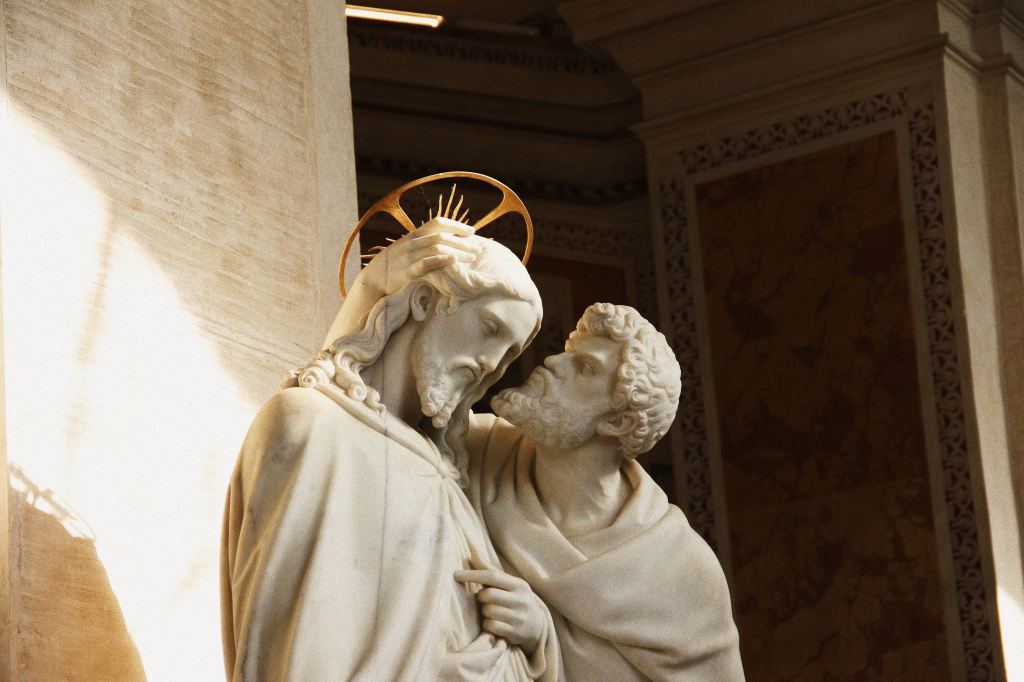
But that doesn’t preach well, nor is it an easy lesson, nor does it give us a model for our own behavior. Maybe it’s not supposed to. Maybe Judas is supposed to force us to look in the mirror, to see the ways in which we too are tragic, and conflicted, and self-preserving, and scared of change. To dismiss Judas as the worst of sinners, to “revile him as a betrayer”, to harbor disdain for him does no justice for Jesus, a victim of state-sanctioned violence. Furthermore, we imperil ourselves when we do not feel Judas’s internal conflict, when we take the gospel writers at their word without considering the forces of power and oppression that were also acting upon Judas that fateful night when he kissed Jesus in the garden. When we ignore the systems that created Judas, opting to supernaturalize his choices, we ignore how the systems that we uphold and participate in now create impossible choices for people. We are less likely to see Judas as human, and anyone else like him as human too.
I once heard that the test of Christianity is not loving Jesus, it is loving Judas. We cannot do that if we continue to vilify him. Poor old Judas. He deserved better than to die of shame and regret. We should all remember that on Good Friday.
They said it wasn’t a real bad stroke, but it must have been bad enough because Mrs. Mabry didn’t come down to the grocery store after that. But that didn’t mean I never saw her again. Now that I knew where she lived, me and Momma went to go check on her, just like we were used to checking on Mr. McCaffree. ‘Course, we had to take the car to where Mrs. Mabry lived, it was too far on foot. But we went once a week to take her some groceries and make sure she had what she needed. She could get around the house alright, but she had trouble with stairs and one of her arms didn’t work so well. Other people went to check on her too, since she didn’t really have nobody. That’s just how folk are around here.
About three months after she came home from the hospital, Momma and I pulled up the house just before dark. I was raining and the storm was getting worse. The mud was sucking at my boots even though I tried my best to avoid it. The paper bags got all wet and I was afraid the canned goods would spill out the bottom all across the yard. By the time we had finished taking the groceries inside me and Momma were both drenched. I felt wet right down to my bones.
Mrs. Mabry couldn’t talk too well, but she always tried. It seemed to tire her out some days. I learned kinda quick how to recognize when she was just bone tired. The rain seemed to be sucking all her pep out of her that day. She just sat in her rocking chair watching me and Momma put the groceries in the fridge and cabinet. She didn’t say nothing as we worked, just watched with a steady gaze. When we were done I went out to the living room to sit on the couch while Momma tidied up a bit.
Sometimes Mrs. Mabry got her paper pad and wrote things down for us, little instructions that she didn’t want to struggle through trying to explain. She still sounded a little like she had marbles in her mouth. She was looking at me with kind of a funny look as I waiting for Momma. She reached to her end table, which was draped with a lace doily that looked like it hadn’t been washed since she put it on the table top, and picked up her pad of paper. It was one of them yellow legal pads. She scratched out a note with her dull pencil and passed it over to me.
I didn’t know when I told you to come visit that you’d be visiting me a lot. I stared at the words for bit, not knowing what to say back to her. I raised my eyes, and she was giving a smile that only raised half of her face. “Why’d you invite me?” I asked, thinking back on that day in the grocery store. She had looked so mean and cruel and scary, not at all like the frail old lady who sat across from me, smiling as best she could.
“Lonely,” Mrs. Mabry said, the single word crawling out of her like a inchworm. It crawled up inside my heart and I felt it trying to find a home there. Lonely.
“Did you think I would come, when you asked?” I had been almost sure it wasn’t a real invitation at the time, but I had been so curious I didn’t care.
There was suddenly a twinkle in her eye. “I hoped,” she said. Then she gestured for the legal pad. I handed it back to her and she slowly scrawled another sentence underneath the one she’d already written. I waited, the scritch-scritch of the pencil the only other sound in the house other than Momma humming while she tidied. Mrs. Mabry handed the legal pad back to me. The word nearly stopped my heart, but not stopped it cold. Almost like, it stopped it warm, if that makes any sense. Like my whole heart was ready just to burst with something that felt good that I couldn’t identify. Pride, or maybe joy, or perhaps even love.
You remind me of me when I was young.
I looked up at her and I smiled a big smile. “Will you tell me about it?” I asked. I handed the legal pad back to her.
Getting a Masters in Religion, especially since I focused on Biblical Studies, has filled my head with a number of things that I would love to hear and say from the pulpit. Hard topics are not typically the ones that get preached, but it is the hard topics that captivate my imagination the most. What if instead of giving easy answers that always point towards the fulfillment of scripture in Jesus’ ministry, we really let people wrestle with the text, the way Jacob wrestled all night, and was wounded for the rest of his life because of it? What if instead of always coming back to the same ideas of grace, mercy and love, that we recognized without our scriptures are stories that we can easily use as proof to do the opposite? I have no idea if I will ever get to share these ideas in a more public way, but it feels right to voice them nonetheless.
Hagar and Sarai (Gen 16)
Can we stop looking at this text as if one of the women loses and the other gains? I don’t see anyone in this story gaining anything other than a complicated mess. If we push past the tendency to pick a side, I think we can see that both women are trapped in systems that do not benefit either one of them, and these systems also prevent them from working towards their mutual good.
Samuel and Eli (1 Sam 3)
Can you imagine being a child and having to tell Eli, the priest of all Israel, that his sons are so corrupt, and that it reflects on his leadership? Do you hear the quaver in Samuel’s voice when he tells Eli that he will be replaced? Do you feel the weight of the words he speaks, a small voice given authority to speak the truth to a mighty power? And what is Eli’s response? “Let it be.” What a perfect example of humility.
Vashti (Esther 1)
Vashti said no. She said no to being used, to being a tool for the powerful, to being a plaything for her husband and his friends, to be a possession to prop up his ego. She said no despite what it would cost her. How brave.
The Woman Healed from Her Flow of Blood (Mark 5)
The desperation that drove this unnamed woman to touch the hem of Jesus’ garment must have been so powerful, that the story made a remarkable impression upon the writer of the text. Her story interrupts the story of a man asking for healing for his daughter. Her story represents the millions of people who live with chronic illness and yet somehow must live their lives. That Mark includes a case of healing from gynecological disease should give us hope that the gospel is powerfully inclusive. Jesus’ ministry includes women’s and reproductive health. Are we preaching the same kind of gospel?
The Faith of the Father of a Demon Possessed Boy (Mark 9)
Asking for a miracle for his son, this unnamed man utters “I believe! Help my unbelief.” And isn’t that a wonderful five word summary of the whole journey of faith?