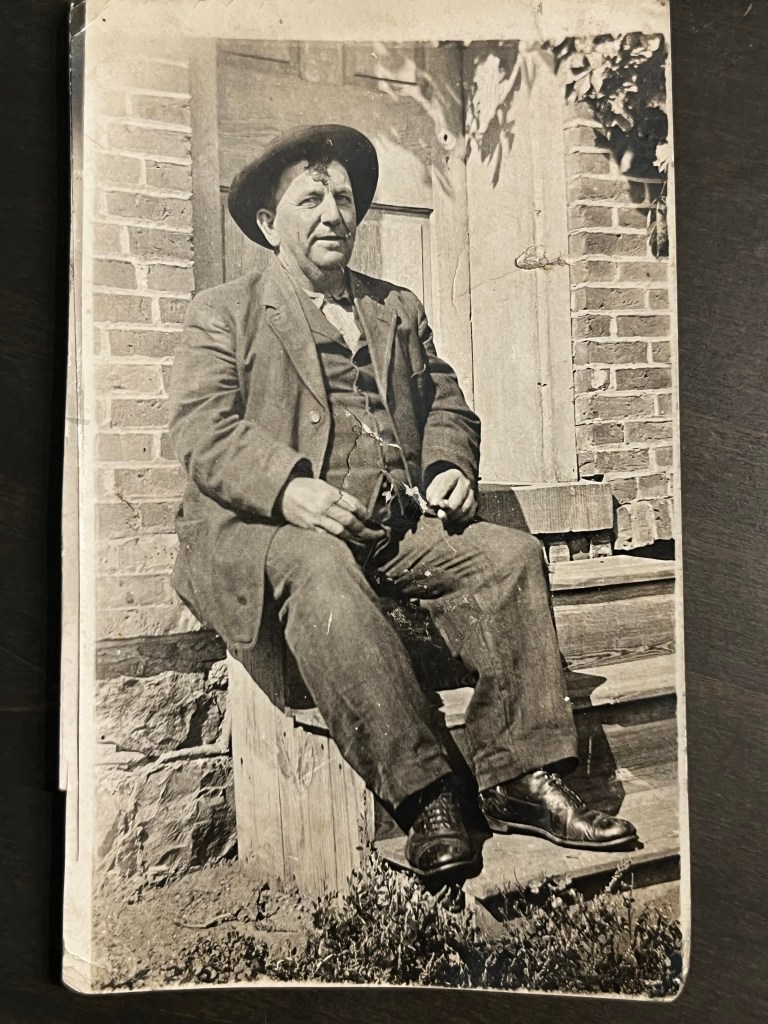
Sometimes when I am outside in the garden or doing yard work, especially if I’m planting something new, or digging out something old, I think about this certain man I never knew. His name was George and he lived a long time ago somewhere in northern Indiana. He had a farm and a wife named Ellen and a dog and rifle and a horse, and wooden porch on the front of his house where at least once in his life he posed with friend, and at least once posed by himself, and few times posed with Ellen and their daughter Ethel. I only know who he is because there are photographs of him (and Ellen, Ethel, the dog, the horse and the rifle), standing on that wooden porch. He looks proud. Content. Weathered. Tough. He looks a lot like my grandfather. He was, after my grandfather’s grandfather.
I think about him when I’m gardening and planting because most of those pictures were taken outside, sometimes with the rifle and sometime with the dog, and sometimes with the horse. He posed in his fields and on his porch for reasons unknown. We don’t know who took the photos of George and Ellen and Ethel. What did he plan to do with the photos? They ended up in a box in the basement of my parents house 100 years or more after they were taken. I wonder if he imagined that’s where his memory would go to rest one day, and I wonder if he would have worn something nicer if he had known that these photos are how he would be remembered.
I think about George and wonder what his life must have been like on that farm. Tilling, planting and harvesting, before modern machinery was affordable to a farmer like him. I wonder what kept him up at night. It doesn’t seem like it would be anything like what keeps me up at night. What does a farmer born in the late 19th century worry about? The weather. The harvest. The winter. Sickness. Spoiled food. Vermin. Maybe that’s why he had the dog. That’s almost certainly why he had the rifle. Dgos and rifles are excellent deterrents for rats, raccoons, opossums, moles, groundhogs, squirrels, chipmunks, rabbits and mice.
I don’t ever worry about vermin. Or spoiled food. I sometimes worry about sickness, especially after 2020, but I never worry about the harvest or the weather. I don’t like the winter, but I know I’ll survive it. I’ll have enough, and if I run out, there’s always more at the store.
Maybe George worried about different things: Ellen, when she was pregnant. Maybe he worried about the baby, Ethel. I can understand that worry. I’ve been through the uncertainty, and even with midwives and hospitals, it’s still unnerving. He must have worried about his son-in-law in 1917, when he went to Europe, to war. I don’t know if I’ll ever have that worry, but even if I do have a child in the armed forces one day, that’s a long way off. That kind of worry is farvremoved from me, just like the worry about the harvest,
I think about George (and his dog and his horse and his rifle) when I’m gardening because it’s the closest I’ll ever get to living the same kind of life he lived. I think about him being dirty and sweaty, sore from laboring, standing over a wood fire stove when it’s cold, or on the porch in his rocking chair if it’s hot. I think about him ending his day in the field usually around the time I’m just heading outside. I think about him because he’s a mystery and he’s familiar, and he’s a part of me. I think about what he must have sounded like, how he laughed, if he sang. I think about him and wonder what he would say if he knew I was thinking of him.
My mom never knew George, but my grandpa did. I never knew George’s daughter Ethel, and my mom has few memories of her (she died when my mom was very young). I know a few stories about Ethel, and her husband Fred, but I don’t know any stories about George. I know my grandpa’s brother was named after George, but I never knew him either. The only memories that have come down to me of Geroge are the photographs which Mom and I sifted through one recent afternoon. One day soon I’ll take them out of that box and I’ll put them into an album for safekeeping. And maybe when my kids look through the pictures one day, they’ll think “I wonder what his story is.” And George’s memory will live on.
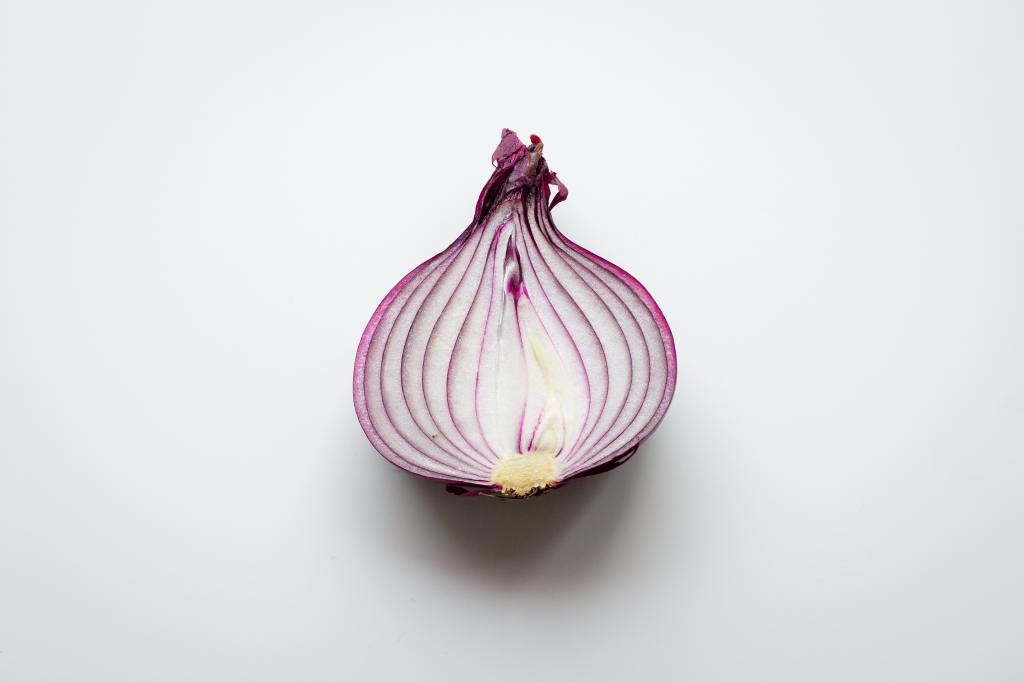
I think it’s true. An onion has a thick outer skin that protects the rest of the bulb. Each layer is thick, until you get closer to the center, where the heart of the onion flakes apart if you touch it just right. It has visible roots and a crispy, paper-thin layer that can’t possibly hide what is underneath.
Yes, I actually am like an onion, more than I care to admit.
But I am tired of being thick and protective.
The things I aspire to be are actually like an onion, too. Maybe that sounds weird to you. Let me explain.
I want to be fragrant, even if it’s off-putting to people. I’d love to be unapologetic about it. An onion does not care if it offends with its flavor. Why should I?
I want to be soft, like onions sautéed in butter, until all the sugars they contain start to brown. I want to be cooked down to my essential elements, shedding the weight of all the things that are not me, like an onion sheds it’s water in the skillet.
I want to be constant. Onions can hang around forever until they start to rot. If you leave one long enough it’ll grow using nothing but the air around it and the sunshine that silently shines through the kitchen window. Yes, I’d love to have the power within me to grow tall and strong.
So, an onion I am. And an onion I’ll strive to be. Complex. Strong. Not for everyone. I’m okay with that.
I know sometimes you get sad, and it feels like there isn’t really a reason. I get that way, too. I just wanted you to know that you aren’t alone in that. It may feel so silly, because you have nothing to be sad about. But I’ve learned something that may help you feel less broken for this unexplained sadness that sometimes gets you down: You aren’t sad “for no reason”, even if it feels like you are.
No, you’re sad because it’s raining. Or it’s winter. Or it looks like it is about to storm. You’re sad because pets die, and stuffed animals get left behind, and there are kids who still have to sleep with nightlights. You’re sad because there are kids with no nightlights, or adults to care about them. You’re sad because even on your best day there are still people who are hurting. You’re sad because you care.
Because the planet feels like it’s slowly dying. Because maybe your kids will one day live in a world without polar bears and elephants. Because no matter how hard you try, you can’t seem to get your tomatoes to ripen, or your houseplants to thrive. You’re sad because despite all the lovely little things around you, it’s all fleeting. Those blossoms will fall. The trees will lose their glorious color. The days will shorten and it will be dark. For a long time.
You’re sad because governments and corporations and revolutions and non-profits, no matter what they say, don’t really seem to care about all people. You’re sad because you want everyone to feel the same love and tenderness that you feel from those in your circle, but not everyone has a circle like yours. You’re sad because despite our best efforts, people are still homeless, and people still starve, and people still can’t get life-saving medical care, and people are still dying with no one to come to their funeral. You’re sad because all of that is inside you, and sometimes it’s just too much to know. Too heavy to carry.
Because the sun will set. Because another hurricane will hit. Because someone will be disconnected for not paying their electric bill. Because somewhere, there is a mother who will refuse to pick up the phone when her son calls. Because there is never enough money for those who don’t already have enough. Because those who have too much will never be willing to share enough of it to make a difference.
You aren’t sad “for no reason.” You’re sad because you’re human, and because you love other humans. You love the planet and all its beautiful, wild wonders. You love day and warmth and light because that is how you were made. And when those things diminish, fade, are obscured, retreat, are hidden…well, that makes you sad.
And you know what? All of that is perfectly okay. I just thought you might like to hear it from someone who knows.
My summer plan is to publish a collection of novellas set in the world of my novels, The World Between and The Chaos Within. The three stories span a great length of time. One takes place before the events of either book, one takes place concurrently to both books, and one takes place after the events of the second book. Below is a short excerpt from one of the novellas: A World Without Magic.
Ethaen smiled broadly as he watched Yunnae’s eyes widen. The silk and lace that Rudanya had laid out before her was astonishing. Even he hadn’t expected Aunt Rudanya to bring back fabrics so fine.
Ethaen’s aunt abruptly cut her off before she could wiggle her way out of picking the fabrics for her wedding gown. “If you don’t like these, I can go back to the shop.”
“Oh! No, it’s not that…” Yunnae looked to Ethaen for help, but he was only smiling encouragingly. “It’s…it’s just that, I…Mistress Rudanya, I can’t afford this cloth.”
Rudanya cast an accusatory gaze towards her nephew. “Did you tell her she had to pay for her gown?”
He smiled widely. “Certainly not, Aunt Danya.”
Yunnae relaxed her face, letting the frown that was forming melt away. “I’ve never worn anything this fine before. It feels…”
“Regal?” Rudanya offered, in place of whatever Yunnae had been about to say.
“Extravagant?” the younger woman squeaked, questioning her own words.
“It’s a wedding, my dear!” Rudanya said, putting an arm around her shoulders. Yunnae, to her credit, did not stiffen in the embrace. “I want you to look like a bride.”
Ethaen rose from his chair near the window. “No use arguing with her, beloved,” he said, coming to Yunnae’s other side. “Besides,” he said softly near her ear, “I think this one is lovely.” He touched the pinkish-lavender silk on the table. It had a cutting of white lace laid upon it.
“I do love the lace,” Yunnae said. “I just don’t know about the silk.”
Rudanya traded out the pink silk for the eggplant. “Better?”
Yunnae looked to Ethaen. “What are you wearing?”
He smiled. “No one is going to be looking at me, my dear.”
Yunnae blushed, bowing her head slightly. “I’ll be looking at you,” she said softly.
Rudanya smiled, remembering how it felt to be in love, and still feeling the old jealousy of not having had the love she wanted. “Eggplant, then?” she asked, wanting a final say.
“It’s my favorite of the three you’ve brought,” Yunnae answered, sounding almost apologetic.
“I can go back to the shop, Yunnae,” Rudanya offered again.
“No!” Yunnae said. “It’s wonderful.” She nodded to herself, as if trying to believe her own words. “I’ll look stunning, I know.”
Rudanya smiled at her. “Yes, you will.” She laid a tray of buttons on the table. “We picked these out as well.”
Immediately, Yunnae’s eye went to the button with the purple stone in the center. “Oh my,” she breathed, picking it up and examining it.
“Gaelta picked that one,” Rudanya said.
A laugh escaped Ethaen. “That’s surprising. She usually isn’t tasteful.”
Yunnae set the button on top of the fabric and lace she had picked. She didn’t even look at the other buttons in the tray.
Rudanya smiled. “I’ll have the dressmaker come tomorrow. What time will be best for you?”
“I have duties with the sick starting at dawn,” Yunnae answered. “Then Contemplation at midday. And I have kitchen duties after that.” She paused, thinking. “I don’t think tomorrow would be the best day. Can we do the day after? I’m not as busy then.”
“Of course,” Rudanya said, writing down a note to hand off to their housekeeper, Heila. “Day after tomorrow, then. We’ll get you measured and have some designs drawn up for you. Is your mother coming?”
“Oh,” Yunnae gasped, as if she had nearly forgotten she had a mother. “I…um, no. I haven’t spoken to her.”
“You haven’t spoken to her?” Ethaen repeated, curious.
“I wrote her a letter,” she began, feeling ashamed.
“A letter?” Rudanya asked. “Does she not live in Celeth-brac?”
“No, Mistress…”
“Please, don’t call me that. Rudanya is perfectly fine.”
Yunnae hesitated before agreeing with a nod. “Yes, Rudanya,” she said slowly. She looked to Ethaen for support and found him smiling encouragingly. She nearly melted at the sight. “She and my father were part of the ithil trade, in the Delta, before Malir stopped running ithil ships. They decided not to come home.”
Rudanya’s lips thinned into a tight line across her face. “They just left you here?” she asked. Ethaen was pleased that she had managed to hide her disgust, but her disapproval was plain in her tone.
“With the Priestesses, yes,” Yunnae answered. “They write to me from time to time.” The way her eyes lost sparkle indicated that she knew this was a weak defense.
“Well,” Rudanya said, “let’s hope they decide to come this way for the wedding.” She really didn’t know what else to say to the woman.
Ethaen looked out the window at the position of the suns. “Yunnae, you don’t want to be late for lessons.”
“Oh! No, of course not. I didn’t realize the time,” she said hurriedly. She kissed Ethaen on the cheek and quickly moved towards the parlor door. In the doorway, she turned. “Thank you for everything, Rudanya.”
“Of course, dear. You’re one of us now. We’ll take care of you.”
For the first time that afternoon, Yunnae smiled brightly; then without another word, she was gone.
Rudanya stared at the spot she had vacated. “It still amuses me that she’s as devoted to you as she is to The Seer. I’m surprised you were able to pull her away from her goddess.”
Ethaen, who was now more practiced at hiding his god-like nature, laughed as if he were a man. “To be honest, it surprises me as well.”
“What about your sister, though? Any luck pulling her out of…” As she caught Ethaen’s glower she let the end of her question die on her lips. “What’s the matter?”
“We paid a price for what we did,” he whispered. “She doesn’t understand it had to be this way.”
Rudanya leaned closer to her nephew. “Does this have anything to do with Jamir?”
Ethaen knew he could trust Rudanya. The partnership between his father and his aunt had kept his uncle’s whereabouts secret for much longer than he had expected. Certainly, The Great Maker had known what he was doing, but Ethaen had never been as sure. He was a traveler, and in all his travels he had seen a multitude of secrets leaked. Rudanya and Malir were as silent as a tomb on the matter. “We didn’t mean for the Concealment to happen. We were only trying to save him.”
“Did you tell her that, before you and Hadlam destroyed that Witch?” Rudanya’s eyes narrowed.
Ethaen slowly shook his head, thinking of how the Red One had burnt to ash under the current of the power they had used against her. “Raelin doesn’t know about Uncle Jamir,” he answered, his soft whisper barely filling the air between them.
“Ethaen, you know what she did, what she helped you do, is slowly killing her,” Rudanya said. She was not angry with her nephew, but she didn’t understand why he had needed her help. Ethaen’s powers hadn’t been Concealed like everyone else’s. Why would such a powerful Mage need the assistance of a barely trained novice? Rudanya had never figured it out.
“I’m not a Mage, Aunt Danya,” he said, an answer to her unasked questions.
She drew back from him, uneasy, her skin prickling with fear. “I know. You’re something different, Ethaen. Something more powerful than I understand.” She paused, letting go of her fear for a moment. “Why did you need her?”
He smiled ruefully, then looked away from her, towards the table where the fabric for Yunnae’s gown still lay. “It took everything I had to hold the world together, and to keep Hadlam from being torn apart as he funneled all that energy into the Red One.” At the Witch’s true name, Rudanya frowned. “He could have never held all the power on his own, Aunt Danya. He would have destroyed himself.”
She nodded, suddenly understanding something that had eluded her before. “Raelin can See, can’t she? That’s why you chose her and not Malir?”
Ethaen nodded, still gazing at the bolts of fabric laid out, the lace delicately draped across the top of each one. “That’s what attracted me to the Priestesses. They don’t fully understand what it is they do, but they tap into that same Deep Power than Hadlam speaks of.”
“The power you can use,” Rudanya added.
Now Ethaen met his aunt’s eyes. “I can’t help Raelin unless she wants to understand. I’ve tried.”
“I know,” Rudanya whispered. “We’ve all tried.”
Ethaen grew thoughtful. “I had hoped Paetir would stay. I tried to convince him not to get on that ship.”
“Did you?” Rudanya asked, seeming to come out of her own thoughts.
“She’s better when she’s with him, don’t you think?”
Rudanya rocked her head side to side while she was thinking. “In some ways. But there’s still that…darkness inside her.”
“It’s not darkness,” Ethaen countered, almost before she had finished her sentence. “No, Aunt Danya. It’s not darkness at all. Raelin has seen the Deep Power. She craves it, but she can’t find it anymore. That’s what’s wrong with her.”
“Well, how do you and Hadlam find it?”
“We’re different,” he explained with a shrug. “And the Deep Power is different now. It surrounds us. It moves through us. It was hidden under the Magic before the Concealment. It was like falling, or diving into a river. Now…” he exhaled. “Now, the only way to find it is to fall inward, inside yourself.”
“Like the Priestesses,” Rudanya murmured.
Ethaen smiled, pleased that his aunt had made this connection. “Exactly.”
I started this writing blog as a way to make myself write more often. I have found it to be cathartic, healing, energizing and inspiring to sit down at the computer, and this “what will I write next for the blog?” As I reflect on a year of intentional writing, here are a few things that come to mind.
“Writing is an act of vulnerability.” I went through a series of difficult personal experiences in 2022, and I can see where all of these hardships come through in the stories and poems that I wrote. Before I started this blog, I told my friend that it was scary to put your thoughts on the page, because it’s like “showing your tits.” He replied that yes, writing is always an act of vulnerability. After publishing The Circle, my sister-in-law joked with me that as she was reading it, she thought “God, what happened to Sarah?” But she went on to say that writing isn’t always about the author, but the author can reveal things that are true about the reader. Reading, then, is also an act of vulnerability. Whenever we choose to engage with writing, whether we are the ones penning the words, or the one reading the words, we take the risk of being stripped bare.
Ideas are easy. I have been surprised by how simple it is for me to come up with an idea for a story. Perhaps this will not always be the case, but over the past year, whenever I sat down to write, there was always something that was easily there, like my mind was an endless filing cabinet of folders. Even so, sometimes the execution of the idea was difficult. I would start to write, only to find that the idea was falling a little flat as I wrote. Or I would write out a scene, and realize that the idea I thought was great was not itself an entire story. I’m not new to these challenges. The problem of having good ideas and poor execution plagued the writing of my first novel, The World Between. I wanted this blog to pay respect to all the unconnected pieces, and I’ve glad that I was able to give some of the stories that didn’t go anywhere some exposure this year.
Weekly blog posts are harder than I imagined. The energy it takes to keep up this level of creativity is sometimes not possible. Thankfully, I had a well of past projects to help me keep to my goal of posting every week. I am hoping that I will be able to continue this pace, but I am also not going to worry myself too much if I have to cut back. As I look ahead to new projects- like 2 short story collections, releasing audiobooks and perhaps doing a second book of poems- this blog might have to evolve. But I also anticipate that this blog will continue to be a springboard for my new ideas- even if they might not pan out.
Nearly every time I read through the instructions in the Hebrew Bible, I wonder what the text might look like if it was brought forward into the modern world. I don’t think we would be bringing animals and fruits from our fields and gardens. These are not the tokens that we find meaningful now. Below is a reimagining of the offerings from the book of Leviticus. If we followed these instructions, how would it change us and the way we interact with each other?
These are the offerings that you must bring to the altar of the LORD your God, so that you please the LORD your God.
The peace offering is to be brought to the altar when you have offended a neighbor. For an unintended offense, bring a large coffee, hot or iced as your neighbor prefers. You must make any dietary modifications as required or else the peace offering will not be accepted. For an intended offense, you must bring a gift card to your neighbor’s favorite restaurant, in an amount that will cover a meal for them and all their household. Lay the peace offering on the altar of the LORD when you have offended your neighbor. The peace offering must also include a prayer of repentance, whether the offense was intended or unintended, so that you may please the LORD your God.
The gratitude offering is to be brought to the altar when a neighbor has done you a courtesy. The gratitude offering is to be a hand-written letter expressing why your neighbor’s actions had a positive impact on you. Bring the gratitude offering to the altar of the LORD as often as you receive courtesy from your neighbor, so that you may please the LORD your God.
The humility offering is to be brought to the altar when you have lost your temper. If your humility offering is for something small, like a miscommunication or a disagreement about a work project, the offering is to be houseplant that is not easily killed. If the humility offering is made because of a larger blowout, like a fight with a family member on a holiday, the offering is to be a something that can be planted in the yard, like bulbs for the garden, or a fruit tree. Bring the humility offering to the altar of the LORD. The humility offering must also include a prayer of repentance, whether you lost your temper over something small or something large, so that you may please the LORD your God.
The replacement offering is to be brought to the altar when you have accidently lost or destroyed your neighbor’s property. Whatever it was that you lost or destroyed, whether a book, a piece of Tupperware, or an item of clothing, bring an identical item to the altar of the LORD. If you cannot afford to bring a replacement for the item that you lost or destroyed—if for example, the item was something costly like a vehicle, or irreplaceable, like a piece of jewelry from a deceased relative—then the replacement offering is to be a notarized letter stating that you will perform household chores for your neighbor until your labor has paid for the item you lost or destroyed. Your neighbor may not take advantage of you when you are doing this labor and must release you from the labor after the cost of your labor has paid for the cost of the lost or destroyed item. If your neighbor takes advantage of your labor, you are to ask the priest to intervene in the dispute, and the LORD will decide between you and your neighbor.
The empathy offering is to be brought to the altar when you have dismissed your neighbor. Whether this was intended or unintended, the empathy offering must still be brought, so that you may please the LORD. The empathy offering is to be a handmade item that you designed with the dismissed person in mind. It can be anything you feel is fit for your neighbor—a piece of pottery, a drawing, a fibercraft, an original piece of music, a poem or short story. Bring the empathy offering to the altar of the LORD. It must also include a prayer of repentance, whether the dismissal was intended or unintended, so that you may please the LORD your God.
These are the offerings that you must bring to the altar of the LORD your God, so that you please the LORD your God.
Photo made available through the Library of Congress
I knew I would have girls. I can’t explain how I knew, other than to say I envisioned them, and brought them to life. As if they manifested out of the dreams I had of them before they were born. When they were growing inside me, I knew who they were. I imagined how they would be. I felt their spirits residing in me and they felt different than my son. I thought about a family portrait hanging on the wall and saw that it had two little girls. Girls who would be like me.
When I think about the ways in which my girls are like me, it involves a level of creativity that continues a tradition of my matrilineal line. They are constantly asking me for art supplies so they can make things for themselves and their friends. My girls watch me make things- wreaths, blankets, mittens, scarves, gloves, jewelry, art, decorations. I picked this up from my mother. She always had a project going. Even now, when I visit her, I see all her threads, needles and yarn piled neatly on the side table, or tucked safely in a bag. I have a basket that serves the same purpose at my house. Her mother created ceramics, plastic canvas decor and toys, sewed her own clothes. One summer she made a dollhouse while she was recovering from a broken hip. Her mother made doll clothes, and a years long project she worked on (re-creating the dresses of the First Ladies of the United States) is on public display in the library where she lived in Constantine, MI. My matrilineage is creative. In this family, we make things.
When my 7 year old asked me to take her shopping for supplies for a project a few weeks ago, we wandered the aisles of Joann Fabrics looking for exactly the right items to buy. At one point we stopped in front of the modeling clay, and as I was looking at all the colors available, I reminisced about my own mother taking me shopping at Michael’s to buy modeling clay, so I could sculpt bears and mice and frogs. My daughter asked me if she could have some, so she could try it out. While I was crocheting a few nights later, my 5 year old asked me to show her how to make the stitches. She practiced for a little while before she handed the hook back to me. I’ve been asked to show them knitting, embroidery, cross stitch, plastic canvas, sewing, painting. When I look around my house and she all the things that were made by Grammy and Mom, these questions of “show me how” bring a smile to my face.
It’s strange though, having this heritage but not having a name to connect it. I would say that my girls are following the Orr tradition, but Orr is my father’s name, not my mother’s. So I could think that me and the girls are like the Kilpatricks. But this isn’t right either, because Kilpatrick is my grandfather’s name, not my grandmother’s. So, perhaps this is a Burgener trait. Grandma Burgener, after all, is the one who made the doll dresses, the one who taught my Grammy, who is turn taught Mom, who then taught me. But Burgener was her married name. Before that, she was Wittenberg, but Wittenberg was her father’s name…
What, then, do I call this heritage? What is the name of the passing of tradition from mother to daughter? How do we talk about the things we learned from our mothers, that we pass on to our daughters, when the names of the women have been erased, replaced by the names of the men who were tied to them? How can I describe myself and these girls when I don’t know the names of the women who gave these traits to me?
I can think of myself in terms of what I do know. I am Sarah, daughter of Barbara, daughter of Evelyn, daughter of Vernie. Beyond that I’m not sure. What I do know for sure though, is that this matrilineage lives as long as I remember it. So I will teach these little girls the names of the women who came before them, who passed down this love of creating. Maybe they will come up with a name for it when they are grown. Or perhaps they will think of themselves as daughters of Sarah, daughter of Barbara, daughter of Evelyn, daughter of Vernie. Either one is fine with me.